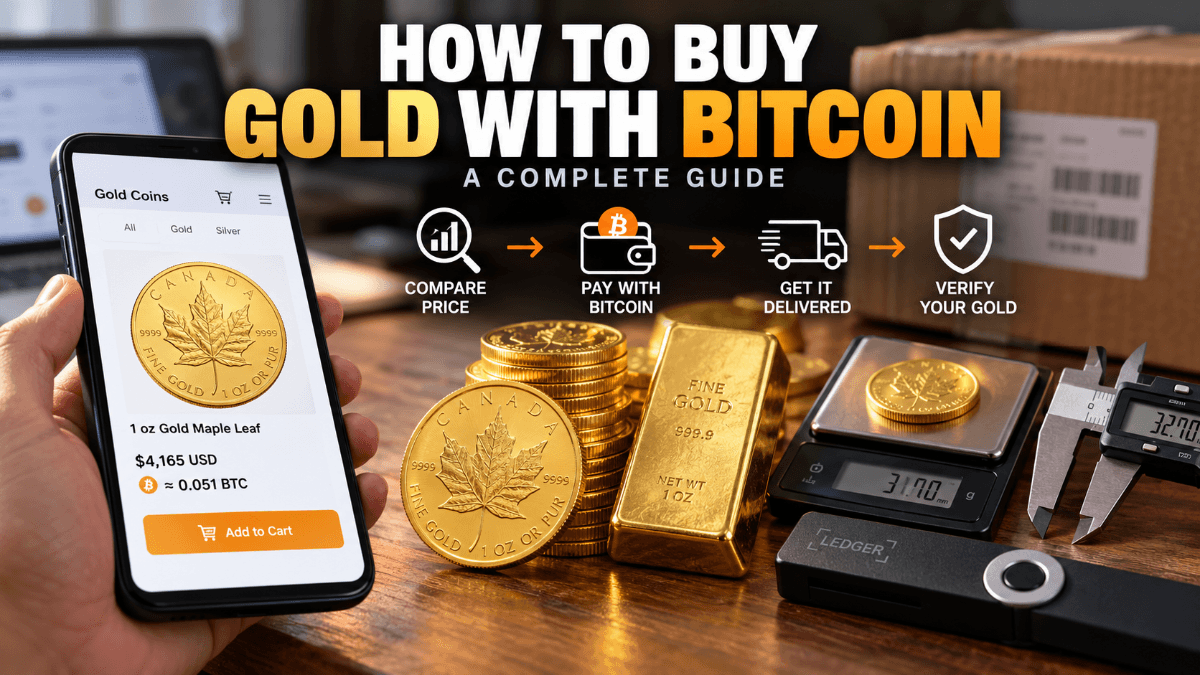
Buying physical gold with Bitcoin combines two different ways to hold value: a decentralized digital asset and a tangible precious metal. You can complete the entire process from your phone, from comparing gold prices and selecting a dealer to sending Bitcoin and arranging delivery.
However, buying gold with cryptocurrency requires more than scanning a QR code. You need to understand dealer premiums, Bitcoin transaction fees, payment confirmations, shipping insurance, and how to identify counterfeit coins before adding them to your collection.
Crypto-friendly dealers such as BTC Mints list gold and silver products with cryptocurrency payment options. Before placing an order, compare the dealer's final price with the current gold spot price and review its shipping, refund, and payment policies.
This guide explains how to buy gold with Bitcoin safely, what costs to expect, which tools can help verify your purchase, and what to consider before converting cryptocurrency into physical gold.
Bitcoin vs. Gold: Understanding the Price Relationship
Bitcoin and gold are often discussed as alternative stores of value, but they behave differently. Gold has a long history as a physical monetary asset, while Bitcoin is a digital asset whose market price can fluctuate significantly over short periods.
Their prices also move independently. Gold can rise during periods of economic uncertainty, while Bitcoin may experience sharp rallies or declines driven by liquidity, investor sentiment, regulation, and broader cryptocurrency market conditions.
For example, a historical market snapshot dated October 17, 2026, placed gold near $4,165 per troy ounce and Bitcoin near $81,600. Using those illustrative figures, the equivalent price of one ounce of gold would be:
$4,165 ÷ $81,600 ≈ 0.051 BTC
That is approximately 5.1 million satoshis, the smallest commonly used unit of Bitcoin.
These figures are a dated example, not verified live quotes. Prices change continuously, so check a current gold benchmark and Bitcoin exchange rate before making a purchase.
Why the Bitcoin-to-gold ratio matters
The BTC-to-gold ratio tells you how much Bitcoin is required to buy a particular quantity of gold at prevailing market prices.
For example:
If Bitcoin rises relative to gold, fewer BTC may be needed to buy the same amount of gold.
If gold rises relative to Bitcoin, the same gold purchase may require more BTC.
If both assets fall against the dollar, the BTC-to-gold ratio can still move in either direction.
The actual amount you pay will usually be higher than the spot-price equivalent because physical gold products carry dealer premiums, shipping costs, and potentially payment or conversion fees.
How to Buy Gold With Bitcoin: Step-by-Step
Step 1: Choose a reputable dealer that accepts Bitcoin
Start by finding a dealer that sells physical gold and explicitly supports Bitcoin payments.
Crypto-friendly dealers may list gold bullion coins, bars, and silver products with prices displayed in fiat currency, cryptocurrency, or both. BTC Mints is one example of a website offering gold and silver products with Bitcoin purchasing options.
Before choosing a seller, check:
Business identity: Look for verifiable company information, contact details, and a clear business presence.
Product descriptions: Confirm the metal, weight, purity, mint, and condition of each product.
Pricing transparency: The checkout page should clearly show the product price, shipping, insurance, and any additional charges.
Payment terms: Find out whether the seller accepts Bitcoin directly or uses a third-party payment processor.
Delivery and returns: Review shipping timeframes, signature requirements, cancellation rules, and refund procedures.
Independent reputation: Search for credible reviews and complaints outside the dealer's own website.
A professional-looking website alone does not establish that a dealer is trustworthy. For a significant purchase, consider contacting the seller before sending payment and verifying its policies in writing.
Step 2: Compare the price with the gold spot price
The gold spot price is the market reference price for gold, generally quoted per troy ounce. One troy ounce equals approximately 31.1035 grams.
Physical coins and bars normally cost more than spot because dealers must account for manufacturing, distribution, inventory, and operating expenses.
The difference is called the premium over spot.
Use this formula to calculate it:
Premium (%) = [(Dealer price − Spot value) ÷ Spot value] × 100
For example, suppose a one-ounce gold coin has a spot value of $4,000 and the dealer charges $4,160.
The premium is $160, or 4%.
This example is illustrative rather than a current market quote.
Compare equivalent products rather than comparing a collectible coin with a standard bullion bar. Premiums can differ considerably according to product type, availability, condition, and demand.
Also distinguish between the purchase premium and the resale spread. A dealer might sell a coin above spot but buy it back below spot. That difference affects how much you could recover if you later sell your gold.
Step 3: Calculate the total cost in Bitcoin
Once you have identified a suitable product, calculate the amount of Bitcoin required at checkout.
Suppose a dealer lists a gold coin for $4,160 and the applicable Bitcoin conversion rate is $81,600 per BTC.
The approximate Bitcoin payment would be:
$4,160 ÷ $81,600 = 0.05098 BTC
However, your final checkout amount may differ because the dealer could use its own exchange-rate source, add processing charges, or lock the quote for only a short period.
Check these details before paying:
The exchange rate used to calculate the BTC amount.
Whether the quote is locked and when it expires.
Whether the quoted amount includes all taxes and shipping.
Whether a payment processor charges an additional fee.
Whether underpayments or overpayments create extra charges.
Whether refunds, if permitted, are made in BTC or fiat currency.
Bitcoin's price can change between checkout and payment confirmation. A clear quote-lock policy helps prevent disagreements about the amount owed.
Step 4: Pay using a wallet you control
For a self-custody wallet, you control the private keys rather than relying entirely on an exchange to hold your Bitcoin.
At checkout, the dealer may provide a Bitcoin address, a QR code, or a supported payment request.
Before approving the transaction:
Open your wallet and scan or enter the payment details.
Verify the recipient address and amount.
Confirm that the payment uses the correct Bitcoin network.
Review the transaction fee.
Approve the payment only after checking the details on your trusted device.
For larger purchases, a hardware wallet can help protect private keys by keeping them away from a general-purpose computer or phone. Verify the destination address on the hardware wallet's own screen whenever supported.
This matters because malware can replace a copied cryptocurrency address with an attacker's address. Checking only the address displayed on a potentially compromised computer may not be sufficient.
Never share your seed phrase or private keys with a dealer or payment processor. A legitimate seller does not need them to receive Bitcoin.
Important: Bitcoin transactions are generally irreversible once confirmed. If you send funds to the wrong address or an impostor, recovery may be impossible.
Step 5: Understand Bitcoin network fees and confirmations
Bitcoin network fees compensate miners for including transactions in blocks. Fees depend on network demand and transaction size, not simply on the dollar value of the gold order.
A transaction with a low fee may take longer to confirm during busy periods. Bitcoin blocks are produced approximately every 10 minutes on average, but block intervals vary and a transaction is not guaranteed to confirm within a fixed time.
The required number of confirmations depends on the dealer's payment policy, the transaction amount, and its risk tolerance.
A payment with one confirmation has been included in a block. Additional confirmations make a transaction progressively more difficult to reverse, although no fixed number guarantees absolute finality.
Before paying, check whether the seller:
Accepts an unconfirmed transaction as payment received.
Requires one or multiple confirmations before processing an order.
Supports Lightning payments or only on-chain Bitcoin.
Has a policy for delayed, replaced, or underpaid transactions.
Do not assume that a transaction has been completed merely because your wallet says it was sent. Check the transaction ID and the dealer's order status.
Step 6: Confirm shipping, insurance, and delivery
Physical gold introduces risks that do not exist when you hold Bitcoin digitally. Your order must travel through a shipping and delivery process before you can inspect the metal.
Review the seller's delivery policy before completing checkout.
Confirm the following:
Whether shipping is tracked and insured.
Whether insurance covers the full declared value of the shipment.
Whether someone must sign for the package.
What happens if the package is delayed, lost, or visibly damaged.
Whether the carrier delivers to your location.
Whether import duties, customs charges, or local taxes apply.
If you are ordering internationally, check the destination country's rules for importing precious metals and receiving cryptocurrency-funded purchases.
Keep the order confirmation, invoice, payment transaction ID, shipping information, and any customs documentation. These records can help resolve delivery disputes and establish your purchase history.
When the package arrives, inspect it before placing the gold in long-term storage.
How to Verify Gold Coins and Bars at Home
A low-cost testing kit can help identify suspicious products, but no single inexpensive tool can conclusively authenticate every gold coin or bar.
For basic screening, a digital scale, digital caliper, and strong neodymium magnet are useful starting points.
1. Use a precision digital scale
A scale measures the product's weight. Choose a scale with suitable capacity and resolution, ideally 0.01 gram for small bullion products.
Compare the result with the manufacturer's specifications for the exact coin or bar.
Remember that some coins contain one troy ounce of pure gold but weigh more than one troy ounce in total because they also contain other metals. For example, a one-ounce gold coin made from a 22-karat alloy can have a gross weight above one troy ounce.
Always compare against the correct product specification rather than assuming every one-ounce coin must weigh exactly 31.1035 grams.
2. Measure dimensions with digital calipers
Calipers measure a coin's diameter and thickness. Compare those measurements with the mint's published specifications.
Weight and dimensions together can reveal some counterfeits that might pass a simple visual inspection.
Use care when handling collectible coins because careless measurement can scratch or damage their surfaces.
3. Perform a magnet test
Gold is not ferromagnetic, so a strong magnet should not attract a genuine gold coin or bar.
However, a negative magnet test does not prove that a product is genuine. Many non-gold metals are also nonmagnetic, and counterfeiters can use materials that pass this basic test.
A magnet is a screening tool, not a complete authentication method.
4. Consider professional testing for expensive purchases
For higher-value items or anything that raises concerns, seek testing from a reputable bullion dealer, precious-metals specialist, or qualified assayer.
Depending on the product, available methods include:
Electrical conductivity or eddy-current testing: Can help assess whether a metal's electrical properties match expectations.
Ultrasonic testing: Can help detect internal inconsistencies in suitable bars and products.
X-ray fluorescence (XRF): Estimates surface elemental composition, but may not detect a counterfeit core beneath a genuine-looking surface.
Density testing: Compares measured density with the expected value, subject to the method's limitations.
No test is universally suitable for every coin, bar, or counterfeit construction. Professional assessment may combine multiple methods.
Avoid damaging acid tests or scratching a product unless a qualified professional has determined that such testing is appropriate.
What Does It Cost to Buy Gold With Bitcoin?
The total cost is more than the Bitcoin amount displayed next to a product.
- Gold premium - The amount above the spot value of the metal
- Bitcoin network fee - The fee paid to miners for an on-chain transaction
- Payment processing - Any additional charge imposed by the dealer or processor
- Shipping and insurance - Delivery fees and coverage for loss or damage
- Taxes and duties - Applicable sales taxes, VAT, customs duties, or other charges
- Resale spread - The difference between the price at which a dealer sells and buys back gold
To compare dealers fairly, calculate the total amount payable and divide it by the quantity of fine gold received. That gives you a more useful cost-per-gram comparison than the advertised coin price alone.
A dealer with a slightly higher listed premium may still offer a better total deal if shipping and processing fees are lower.
Tax Considerations When Buying Gold With Bitcoin
Using Bitcoin to purchase physical gold can create tax obligations even if you never convert the Bitcoin into cash.
In some jurisdictions, spending cryptocurrency is treated as a disposal of the digital asset. The taxable gain or loss may depend on the difference between the Bitcoin's cost basis and its value when you spend it.
The gold purchase may also trigger separate tax rules, such as sales tax, VAT, import duties, or reporting requirements. The treatment depends on your country, the type of gold product, and the circumstances of the transaction.
If you are in India, do not assume that a crypto-funded gold purchase is tax-free simply because no Indian rupees changed hands. Cryptocurrency taxation, precious-metals taxation, and import rules can involve different legal provisions.
Keep records of:
The date and amount of Bitcoin spent.
The Bitcoin acquisition cost and relevant transaction records.
The fiat value of the payment at the time of purchase.
The gold invoice and product specifications.
Any fees, taxes, and shipping or import charges.
For a substantial transaction, consult a qualified tax professional familiar with cryptocurrency and precious metals in your jurisdiction.
Final Thoughts
Buying physical gold with Bitcoin can be straightforward when you approach it as two separate transactions: spending a digital asset and purchasing a physical commodity.
Start with a reputable dealer, compare its price with spot, calculate the total cost in Bitcoin, verify the recipient address on a trusted device, and understand the confirmation and refund policies before sending funds.
Once the gold arrives, inspect the package and compare the product's weight and dimensions with official specifications. For a high-value purchase, professional authentication is worth considering.
The key is not simply finding a dealer that accepts Bitcoin. It is making sure that the price is competitive, the payment process is secure, and the gold you receive is authentic.
Frequently Asked Questions9 FAQs
Quick answers to common questions about this topic
Yes. If the dealer supports mobile Bitcoin payments, you can select a product, review the quote, scan the payment QR code, and authorize the transaction from your wallet. For larger orders, consider using a hardware wallet to verify the destination address on a trusted screen.
Yes, some cryptocurrency-friendly dealers offer both bullion coins and bars. Compare purity, weight, product premiums, recognized refiners or mints, and resale options before choosing between them.
Yes, provided the dealer accepts Bitcoin for silver products. The same payment-security and delivery checks apply. Silver generally has a lower purchase price per unit than gold, but its premiums, storage requirements, and shipping costs can differ substantially.
There is no universal requirement. Some dealers may use different confirmation policies depending on order size and payment method. Read the payment instructions and wait for the seller to acknowledge the transaction before assuming the order is being processed.
The outcome depends on the dealer's quotation policy. A seller may lock the BTC amount for a defined period or recalculate it if payment arrives after the quote expires. Check the terms before sending funds.
That depends on the seller's terms, the reason for the refund, and applicable consumer-protection rules. Cryptocurrency transactions generally cannot be reversed through the Bitcoin network itself. If a refund is approved, the dealer may return Bitcoin or use another method under its stated policy.
Start with the correct weight, dimensions, visual details, and magnet response. These checks can reveal some suspicious products but cannot guarantee authenticity. For expensive items, use a reputable professional who can apply suitable testing methods.
The answer depends on your jurisdiction, the dealer, the source of the funds, and any applicable financial, tax, import, or reporting requirements. Verify the rules that apply to your location before placing an order.
Neither option is automatically better. Direct Bitcoin payment may be convenient if a dealer offers a competitive quote, while selling Bitcoin first may provide more flexibility when comparing multiple gold sellers. Compare the total costs, tax consequences, and payment protections for both routes.