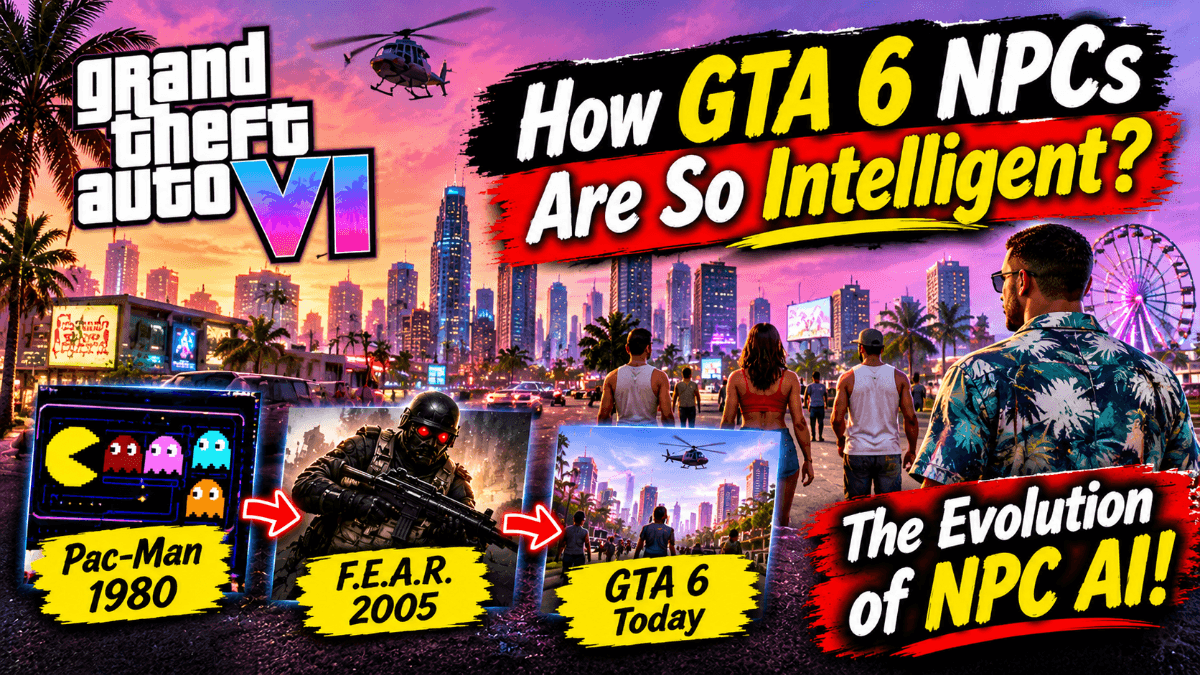
Imagine walking through the streets of Vice City in GTA 6. You pull out a gun, and suddenly, the people around you start reacting differently.
One person runs away in fear. Another calls the police. Someone else might even try to fight you.
Now, here's an interesting question: Are these characters just following predefined computer instructions, or is something more intelligent happening behind the scenes?
For years, video game developers have been trying to make non-player characters (NPCs) behave more like real people. And the technology behind them has evolved significantly. But, where did that intelligence come from?
What Makes an NPC Intelligent in a Video Game?
NPC stands for Non-Player Character. These are all the characters in a video game that are not directly controlled by the player.
Think about pedestrians walking around in GTA, shopkeepers in RPGs, enemies in shooting games, or friendly characters giving you missions.
Their behaviour is controlled by different programming systems, commonly known as game AI.
But here's something interesting: Most video game NPCs don't actually think like humans.
Instead, developers combine different techniques to make their behaviour appear intelligent.
These systems help NPCs:
React to the player's actions.
Navigate through the game world.
Follow routines and predefined goals.
Make decisions based on their surroundings.
Interact with other characters.
Respond differently to different situations.
The real magic is creating the illusion that these characters have their own lives.
And this journey started much earlier than modern open-world games.
1980: Pac-Man's Ghosts and Their Simple Rules
To understand the history of NPC AI, we need to travel back to 1980. That's when Pac-Man became popular in arcades.
At first glance, the ghosts in Pac-Man might look like simple enemies chasing the player. But they were actually designed with different movement behaviours. Each ghost followed its own mathematical rules.
For example, Blinky aggressively chases Pac-Man, while Pinky attempts to position itself ahead of the player. Other ghosts use different targeting strategies.
This meant that the ghosts didn't simply move randomly around the maze. Their movement was designed to create different challenges for the player. Of course, they didn't have human intelligence. They followed carefully programmed rules.
But this was an important lesson for game developers: Even simple rules can create the impression of intelligent behaviour.
And video game AI was about to become much more interesting.
2005: F.E.A.R. Shocked Everyone
Fast forward to 2005. The enemies in F.E.A.R. talked to each other, took cover and surrounded the player. Players wanted to know how it was possible.
The answer was GOAP, or Goal-Oriented Action Planning. Developers did not script every step. They gave the enemies goals, such as: “Stay alive, and take down the player.”
The AI worked out the rest. Depending on the situation, it might take cover, flank or fall back. When enemies shouted "He's flanking!", the player felt like a whole squad had made a plan. The shout was partly a way of telling the player what was happening.
This is the second big lesson: give the AI goals, not orders.
GTA 6 NPCs: Several Layers Working Together
Modern open-world games have a much bigger challenge. They don't just need intelligent enemies. They need entire cities filled with characters who make the world feel alive. Making these characters believable requires multiple systems working together. Reports and technical breakdowns point to over 600,000+ individual animations powering the world, organized through three distinct layers working together every second:
1. AI Behavior
Every NPC is assigned distinct personality traits and emotional states. One pedestrian might be hot-tempered and aggressive, another timid, and another overly curious. This dictates how they react when chaos breaks out.
2. Animation Blending
Realistic decision-making falls apart if movement looks robotic. Animation blending allows an NPC to transition seamlessly from one motion to another—such as walking, stopping mid-stride, turning their head toward a loud noise, and breaking into a sprint—without jarring cuts.
3. Environmental Simulation & Memory
An NPC’s choices depend heavily on context—where they are standing, what they can physically see, and what happened moments earlier. Characters can remember your past actions, initiate unscripted interactions, and respond differently each time you encounter them.
Is This Generative AI?
Many people assume modern NPCs run on generative AI. Based on reports, Rockstar has built these systems in-house. That points to hand-crafted systems, rules and decision-making working together, rather than a chatbot generating behaviour on its own. For the most accurate picture, check Rockstar's official statements.
Smart vs. Looking Smart: The Real Lesson
One thing has not changed from Pac-Man to GTA 6. Game AI is not about being smart. It is about looking smart. What has changed is the scale. A 1980 ghost followed one rule, while a modern NPC combines thousands of small rules and decisions.
Final Thoughts
The next time you meet an NPC in a game, remember that you are not talking to a single character. You are dealing with a combination of thousands of small rules and decisions, just like that 1980 ghost, except now it may remember you too.
Frequently Asked Questions5 FAQs
Quick answers to common questions about this topic
NPC AI is the programming that lets non-player characters make decisions and react to the player and the game world.
Yes, but very simple AI. Each ghost had its own rule for choosing a target, and together those rules made their behaviour look varied and clever.
GOAP stands for Goal-Oriented Action Planning. A character is given a goal and picks its own actions to reach it. F.E.A.R. (2005) made the technique famous.
According to reports, Rockstar designed these systems in-house. For official details, refer to Rockstar's announcements.
Usually not. Most game AI aims to challenge the player while keeping the game fun, not to defeat them.