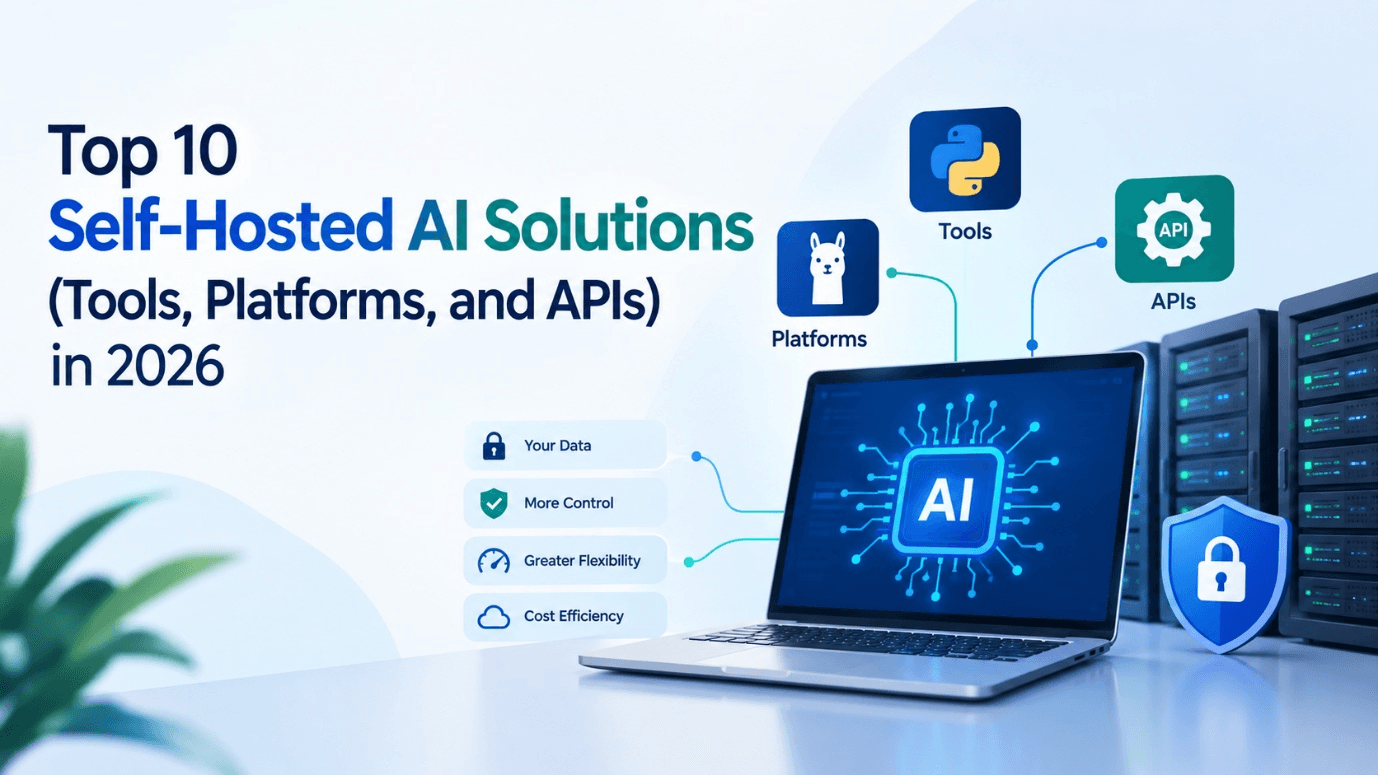
The usage of AI is advancing past the stage where people only rely on hosted chatbots and APIs. Today, organizations and developers are looking to take control of their models, data, infrastructure, costs, and application architecture. Self-hosted AI offers this possibility by enabling businesses to run their models and AI applications on their own hardware, servers, private clouds, and even their data centers.
Yet, finding the right self-hosted AI tool is not easy as the market features all sorts of offerings – from model runners and inference engines, through visual AI builders, APIs, to full-blown AI workspaces. This list from examines 10 notable self-hosted AI solutions of 2026, comparing their features, deployment options, licenses, and use cases.
What Is Self-Hosted AI?
Self-hosted AI is any form of software, models, or services where the person or company manages their own infrastructure on which the AI runs. This infrastructure could consist of anything from a personal computer, private servers, company data centers, VMs, or private clouds.
Self-hosted AI platforms can include uses of AI in the forms of chat applications, code assistance, document analysis, RAG (retrieval-augmented generation), agents, internal knowledge bases, model APIs, automation, and production inference. Deployment depends on the platform and could range from Docker and Kubernetes deployments to desktop apps or python environments, or GPU server.
An important point of consideration here is that the self-hosted software and the self-hosted model are not always one and the same. There could be situations where a platform runs locally but accesses model API externally, whereas there may also be cases where both the app and the model weights run entirely within the company's infrastructure.
What Are the Important Features?
A good self-hosted AI platform should be more than just running the model. Other considerations could be API compatability, hardware compatability, security, deployability, model management, scalability, integrations.
Important features to look for:
- Running Locally Support: Ability to run supported open-weight or open compatible model locally.
- Availability of API: If API is open AI compatible or any other, it will make it more compatible with other apps.
- Compatibility with Hardware: It could be CPU, GPU, Apple Silicon, NVIDIA, AMD, or any other hardware accelerator compatibility.
- Model management: Capability to manage models by downloading, configuring, changing, and upgrading.
- RAG Support: Ability to retrieve models to be able to work with private documents and corporate knowledge.
- Agents: AI agents can help to connect models with various tools, workflows, APIs, and external systems.
- Scalability: For production purposes, you can find some models which will be able to process multiple requests.
How We Evaluated These Tools
For our assessment in this case, we evaluated the capabilities that are important for shifting the AI workloads from the managed cloud services. This assessment included AI solution type, supported model and API, deployment options, hardware requirements, developer experience, workflow capabilities, licensing, and workload suitability.
We also considered how the tool is intended to be used – whether it is meant for local experimentation, development of applications or AI workflows, or for production inference workloads. Consequently, these tools cannot necessarily substitute each other in a 1:1 manner. For example, Ollama and llama.cpp stand out as the solutions best suited for the local model running, while vLLM and SGLang are especially useful for scaling the AI models. Flowise and Langflow represent another way to solve the problem by addressing the application and workflow aspects.
Also, licensing was taken into account because being "self-hosted" does not imply that all components have the same licensing.
Top 10 Self-Hosted AI Tools and Platforms
1. Ollama — Simple Local AI With an Accessible API
Overview
Ollama has become a widely used way to run AI models locally without building an inference stack from scratch. It provides a command-line experience for downloading and running models and is available across macOS, Linux, Windows, and Docker environments. The documentation for Open WebUI also refers to Ollama as a basic model runtime that uses a broad model library and an API compatible with OpenAI.
As a benefit for developers, one of the advantages of Ollama is that its API is compatible. The openAI compatible endpoint makes it possible for the existing applications that use OpenAI client API to connect to the locally running models simply by changing the endpoint API.
Why It Stands Out:
- Simple Model Management: Models can be downloaded, run, and managed via simple commands.
- OpenAI-Compatible API: Applications can connect via OpenAI compatible API format.
- Ollama has access to a wide range of models via the registry.
- Cross Platform Deployment: Ollama works on macOS, Linux, Windows, and Docker platforms.
Self-Hosting Considerations
Ollama is particularly approachable for developers starting with local AI. Production deployments still require attention to authentication, networking, resource limits, model storage, monitoring, and GPU capacity.
License, Language, Deployment, Countries and More
- Software: Ollama
- Primary implementation: Go and supporting components
- Deployment: macOS, Linux, Windows, Docker
- API: OpenAI-compatible
- Availability: Global
- License: MIT software license; individual models can have separate licenses.
Customers / Users
Ollama is used by individual developers, researchers, AI application developers, coding-tool users, and organizations experimenting with local model deployment.
Best For
Ollama is best suited to developers and teams that want a relatively simple starting point for running local models and connecting them to applications through an API.
2. LocalAI — Flexible Private AI APIs
Overview
LocalAI is designed as an open-source AI engine that can run different model types locally or on-premises. Its documentation describes support for language, vision, voice, image, and video workloads, while allowing different inference backends to be installed as needed.
The platform is especially relevant when an organization wants an API layer rather than simply a local chat application. LocalAI provides OpenAI-compatible APIs and also supports Anthropic and other interfaces, allowing existing applications to connect to locally hosted inference.
Why it is special
- Multi-Modal AI: Supports language, vision, audio, images, and video processing.
- Different Backends: Different backend options for inference according to model and workloads.
- Hardware Compatibility: Compatible with many different hardware platforms, such as NVIDIA, AMD, Intel, Apple Silicon, Vulkan, and CPU hardware platforms.
- Distributed Inference: LocalAI allows the use of distributed nodes, federated models, and sharded models.
Self-Hosting Notes
Teams making LocalAI available beyond a single machine need to set up authentication and networking. Its documentation notes that API keys provide access control while its authentication mode supports multi-user capabilities and usage tracking.
License, Language, Deployment, Countries and More
- Software: LocalAI
- Core implementation: Go with multiple inference backends
- Deployment: Local machines, Docker, on-premises, distributed infrastructure
- API: OpenAI-compatible and additional API formats
- Availability: Global
- License: MIT
Customers / Users
LocalAI is suited to developers, organizations, researchers, and teams building private AI applications across multiple modalities.
Best For
LocalAI is a practical option for teams that need a flexible private AI API supporting different model types and hardware environments.
3. llama.cpp — Lightweight and Hardware-Friendly Inference
Overview
llama.cpp is an inference implementation written primarily in C/C++ and designed to make local LLM and VLM inference accessible across a broad range of hardware. The project provides command-line tools as well as a server capable of exposing an OpenAI-compatible API.
Its importance in the self-hosted ecosystem also comes from its hardware flexibility. The framework works with different backends and can be used on various desktop OSs, GPUs, CPUs, and other accelerators.
Why it works
- Efficient Local Inference: Framework is designed to perform local inference using lightweight infrastructure.
- Quantization Support: Quantized models consume less memory than unquantized models.
- Server for OpenAI-API: The current framework version supports the creation of a server for API applications.
- Multiple Backends: Works with CPU and various GPU/accelerator backends.
- Useful for Developers: Being created on C/C++, the framework is very helpful for developers of custom AI applications.
Self-Hosting Considerations
llama.cpp is closer to an inference engine than a complete AI workspace. Teams may need to add authentication, user management, databases, monitoring, and application interfaces separately.
License, Language, Deployment, Countries and More
- Software: cpp
- Language: C/C++
- Deployment: Windows, Linux, macOS, Docker and other supported environments
- API: llama-server with OpenAI-compatible API
- Availability: Global
- License: MIT for the project code; model licenses vary.
Customers / Users
Its audience includes developers, researchers, AI hobbyists, embedded-AI teams, and organizations building applications around local inference.
Best For
llama.cpp is well suited to developers who want direct control over local inference and hardware rather than a large application platform.
4. vLLM — Production-Oriented LLM Serving
Overview
vLLM is designed for high-throughput LLM inference and serving. It includes techniques such as PagedAttention, continuous batching, quantization, streaming, and distributed inference capabilities.
Unlike desktop-first model runners, vLLM is aimed more directly at teams serving models through APIs. Its OpenAI-compatible server makes it possible to connect applications using familiar client interfaces while keeping model inference on privately controlled infrastructure.
Why It’s Unique
- High-Throughput Serving: Built to serve inference requests in high throughput.
- PagedAttention: Facilitates attention key-value memory management during serving.
- Continuous Batching: Many requests can come at the same time and can be efficiently handled.
Self-Hosting Considerations
vLLM generally makes more sense for teams with dedicated GPU infrastructure and production inference requirements. Hardware planning, model compatibility, concurrency, networking, observability, and capacity management become important as usage increases.
License, Language, Deployment, Countries and More
- Software: vLLM
- Primary ecosystem: Python/CUDA and related acceleration components
- Deployment: GPU servers, containers, distributed environments
- API: OpenAI-compatible
- Availability: Global
- License: Apache 2.0 project licensing
Customers / Users
vLLM is aimed at AI application teams, model providers, researchers, and organizations operating inference services.
Best For
vLLM is suited to organizations that need production-oriented model serving, especially where request volume and GPU utilization matter.
5. SGLang — High-Performance Model Serving
Overview
SGLang is an open-source serving framework for large language and vision-language models. Its documentation describes it as a production-level serving system designed for low-latency and high-throughput inference from single GPUs to distributed clusters.
The platform provides OpenAI-compatible APIs and supports a wide range of model and hardware environments. Its current documentation also describes support for NVIDIA, AMD, Intel, Google TPU, Ascend NPU, and other accelerators.
Why It Is Unique
- High-Performance Serving: Designed for fast performance and efficient serving of inference requests
- OpenAI Compatibility: Applications will be able to interact with SGLang through common APIs
- Large-Scale Deployment: Supports both single-GPU and distributed cluster deployments
- Wide Range of Hardware: Supports multiple GPU, CPU, TPU and accelerator ecosystems.
Multimodal Support: Designed to serve both language and vision-language models.
Self-Hosting Considerations
SGLang is more infrastructure-oriented than consumer-focused local AI applications. Teams should have experience with Linux, GPUs, containers, networking, and model-serving operations before using it for large production environments.
License, Language, Deployment, Countries and More
- Software: SGLang
- Primary language: Python with performance-oriented components
- Deployment: Linux, Docker, GPU servers, distributed clusters
- API: OpenAI-compatible and native APIs
- Availability: Global
- License: Apache 2.0
Customers / Users
The platform is aimed at AI researchers, model developers, inference engineers, and organizations operating large-scale model services.
Best For
SGLang is suitable for teams where the inferencing system must be engineered specifically for efficiency and scalability.
6. Open WebUI — A Private AI Workspace
Overview
The Open WebUI is a web-based interface for interacting with the AI models and bridging multiple AI providers using a single workspace. The features offered by this tool include chat, knowledge, tools, search, images, voice, and providers like Ollama and OpenAI-compatible providers.
This distinguishes Open WebUI from just being an inference engine since the latter focuses more on providing model weights while the former provides the user with the application layer to be built over the AI backend.
Why It Stands Out
- Unified AI Interface: Access to various models through a single interface is possible for users.
- Knowledge and RAG: This platform offers solutions that can link AI models with organizational knowledge.
- Compatible Providers for CoProvider: Integrates with Ollama, OpenAI, Anthropic and other compatible providers.
- Function of Teams: Permissions, SSO/OIDC/LDAP, SCIM, Channels, Notes & Automation.
- Extendable Workspace: Various tools, functions, and model configurations are possible to add to the workspace.
Self-Hosting Considerations
Open WebUI's licensing changed over time. Current versions include a branding-protection condition, while older code remains under its earlier licenses. Organizations planning to modify or redistribute the interface should review the current license carefully.
License, Language, Deployment, Countries and More
- Software: Open WebUI
- Deployment: Local machines, servers, Docker and other supported environments
- Integrations: Ollama, OpenAI-compatible providers and others
- Availability: Global
- License: Current Open WebUI License with branding requirements; historical code has earlier licenses.
Customers / Users
Open WebUI is relevant to individuals, development teams, businesses, educational organizations, and groups that want a private interface for multiple AI backends.
Best For
Open WebUI works well for teams that want a complete private AI interface rather than managing models entirely through command-line tools.
7. Flowise — Visual AI Agents and Workflows
Overview
Flowise is a tool that allows creating AI agents and processes visually. Rather than making all the AI applications completely code-based, Flowise offers a visual environment where models, tools, data sources, and workflow components can be connected.
Self-hosting on various platforms, like AWS, Azure, Google Cloud, DigitalOcean, and others, is available, as well as an option to host the application yourself.
Why Is It Unique?
- Visual workflow designer: The artificial intelligence workflow creation can be done using a visual workflow designer technique.
- AI Agent Creation: Users will not need to create everything from scratch since they will be able to build an agent-based application.
- Self-Hosting: Flowise can be hosted internally within the organization.
- Components Integration: Flowise integrates models, databases, tools, API, and other components.
- Different Deployment Options: Organizations can use either cloud infrastructure or internal infrastructure.
Self-Hosting Considerations
The community version is Apache 2.0 licensed, while certain enterprise-related components have separate commercial licensing terms. Organizations should distinguish between community and enterprise functionality before deploying commercially.
License, Language, Deployment, Countries and More
- Software: Flowise
- Primary ecosystem:TypeScript/Node.js
- Deployment: Docker, cloud infrastructure, self-hosted servers
- API/workflows: AI agents, chains, integrations
- Availability: Global
- License: Apache 2.0 for the open-source/community source; enterprise components have separate terms.
Customers / Users
Flowise is relevant to developers, AI engineers, startups, automation teams, and businesses building internal or customer-facing AI workflows.
Best For
Flowise is useful for teams that prefer visual AI development and want to build agents, RAG applications, and workflows without creating every integration manually.
8. Langflow — Visual RAG and Agent Development
Overview
Langflow is a software that allows people to build and launch AI-enabled agents and workflows. The software includes the visual editor and APIs and the MCP server functionalities, which enables the flows to turn into applications or tools.
The tool is compatible with large language models, vector databases, AI tools, and observability integrations. Langflow is available for installation locally or via Docker, which means that developers who need to prototype and then launch AI flows have a good solution.
The features that make it unique.
- Visual Interface: This is a visual interface that helps programmers develop applications through the use of artificial intelligence.
- Customization of Python: This can be customized through the use of the Python interpreter.
- RAG and Agents: It performs the tasks of data retrieval and agent generation among others.
- Deployment of API: This involves deploying flows as APIs to be consumed by applications.
Self-Hosting Considerations
Langflow can be run locally or through Docker, but production deployments still require teams to configure authentication, storage, networking, monitoring, and scaling according to their workload.
License, Language, Deployment, Countries and More
- Software: Langflow
- Primary languages: Python and TypeScript
- Deployment: Local, Docker, servers and cloud infrastructure
- API:API and MCP capabilities
- Availability: Global
- License: MIT
Customers / Users
Langflow is intended for developers, data teams, AI engineers, researchers, startups, and organizations building RAG and agent applications.
Best For
Langflow is a strong fit for teams that want visual development while retaining code-level control over AI components and deployment.
9. Jan — Local AI With an OpenAI-Compatible API
Overview
Jan is a local-first AI application that allows users to run AI models on their own computers. It can work with local models and provides an OpenAI-compatible API server for applications that need programmatic access to local inference.
The platform is designed around local use and privacy.The API server is hosted locally, on the client’s computer itself. Documentation is provided with settings that can be used to configure the server host, API key, and network availability.
Why It Shines
- Local-first design: Models can be run using the user’s own computer resources only.
- OpenAI API-compatible: Applications can be connected to the local server
- Tool calling support: API supports tool calling and multi-turn dialogues.
MCP Integration: Jan supports connections with MCP tools and local workflows.
- Command-Line Serving:Its current CLI can serve local models through an OpenAI-compatible endpoint.
Self-Hosting Considerations
Jan is particularly convenient for personal and development environments. Teams deploying it across shared infrastructure should separately plan authentication, networking, hardware capacity, centralized administration, and monitoring.
License, Language, Deployment, Countries and More
- Software: Jan
- Deployment: Desktop and local server environments
- API: OpenAI-compatible
- Availability: Global
- License: Apache 2.0 for the core open-source platform.
- Hardware: Local CPU/GPU environments depending on the selected model and backend
Customers / Users
Jan is designed for developers, researchers, privacy-conscious users, AI enthusiasts, and teams experimenting with local AI applications.
Best For
Jan is suitable for users who want a convenient local AI application while retaining the ability to connect their own software through an API.
10. AnythingLLM — Private Knowledge and AI Workspaces
Overview
AnythingLLM combines local AI capabilities with document knowledge, RAG, agents, and multi-user workspace features. Its hosted documentation describes the option to self-host with Docker, while enterprise deployments can also use on-premise infrastructure.
The platform is particularly useful for organizations that want employees to interact with company documents and internal knowledge through AI. Its self-hosted terms state that the core software is provided under the MIT License and that the software does not require an external connection to Mintplex Labs servers to function, although optional telemetry and some model assets may involve external connections.
Why It Is Unique
- RAG Workflows: Companies can combine AI with confidential documents and knowledge bases。
- AI Agents: Agents can be employed to do jobs and communicate with connected data sources.
- Support for Multiple Users: Single self-hosted server supports multiple users with separation of tenants.
- Control by Admins: Admins can manage access rights and capabilities of users.
- Deployment and Enterprise Features: The choices to deploy using internal infrastructure along with enterprise features.
Self-Hosting Considerations:
Self-hosting gives organizations infrastructure control, but the responsibility for firewalls, TLS, access control, updates, backups, and host security remains with the operator. AnythingLLM's self-hosted terms explicitly place these infrastructure security responsibilities on the user.
License, Language, Deployment, Countries and More
- Software: AnythingLLM
- Deployment: Desktop, Docker, self-hosted infrastructure, on-premise
- Use cases: RAG, agents, private knowledge, AI workspaces
- Availability: Global
- License: MIT for the core self-hosted software.
Customers / Users
AnythingLLM is aimed at individuals, small businesses, development teams, enterprises, and organizations that want private AI knowledge workspaces.
Best For
AnythingLLM is well suited to teams that want to connect private documents and organizational knowledge with AI without depending entirely on a hosted workspace.
What Are the Key Benefits of Self-Hosted AI?
In-house AI shifts the locus of responsibility for the AI stack infrastructure. It is no longer necessary to outsource the whole stack but to keep control of essential parts of the AI models, applications, data, and infrastructure.
1. Greater Data Control
Sensitive prompts, documents, conversations, and output can be contained within an infrastructure controlled by the organization. This is especially true for regulated workloads and internal business information.
2. More Flexible Infrastructure
It is possible to pick any server, GPU, operating system, container, network architecture, or even deployment environment instead of using one vendor’s infrastructure.
3. Cost Predictability
Self-hosting allows avoiding the reliance on per-request or per-token API charges for workloads that are large, predictable, or often repeated. Nonetheless, costs of hardware, power supply, storage, engineering, and maintenance still have to be estimated.
4. Larger Model Choice
Self-hosted platforms can give teams a possibility to choose among compatible open-weight models without relying on only one hosted model provider. Model licensing and limitations should be reviewed individually.
5. Customization
Teams can customize AI application stack, link to internal databases, develop RAG pipeline, integrate various software, and configure inference.
6. Less Dependency on Vendor
Self-hosting of an AI workload can help avoid the dependency on just one vendor API. Also, standardized APIs can help switching between inference backends.
Conclusion
Self-hosted AI has grown into an ecosystem that consists of local model runners, inference engines, private AI workspaces, APIs, RAG systems, and visual agent builders. There are ten different solutions described in this guide which prove that different workloads need to be handled differently. Ollama, llama.cpp, and Jan have a focus on local inference accessibility, vLLM and SGLang aim at production-grade model serving. Open WebUI and AnythingLLM give users access to a personal AI platform, Flowise and Langflow can beto design workflows and agents. Lastly, LocalAI is equipped with multi-modal inference capabilities via an API. Choosing the appropriate self-hosted AI service is influenced by the hardware capacity, scalability, privacy, knowledge, licensing issues, and type of workload.