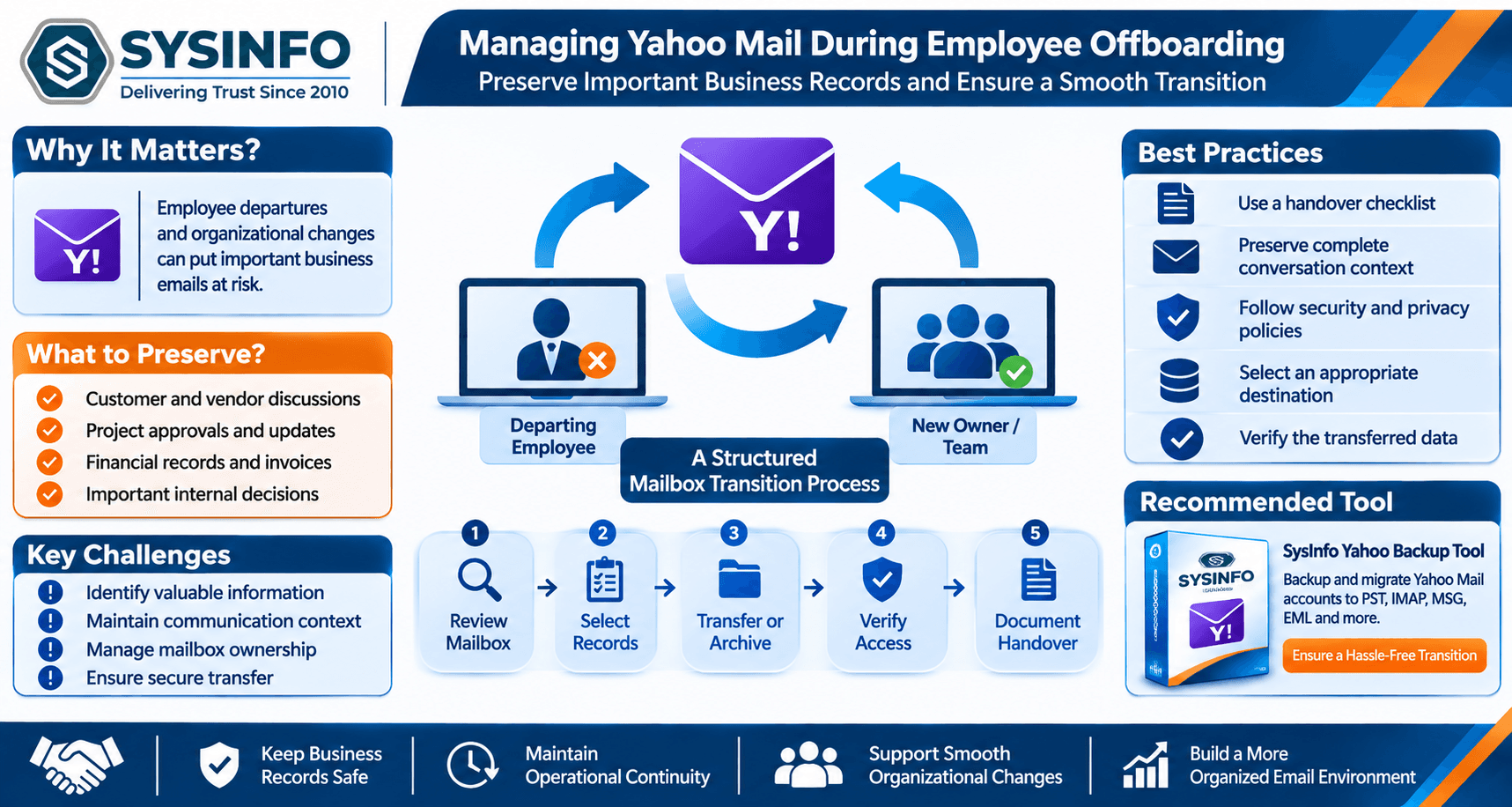
Employee departures and organizational changes often create challenges for business email management. When an employee leaves a company, changes departments, or transfers responsibilities to another team, their email account may contain important business information that other employees still need.
Customer discussions, vendor agreements, project approvals, invoices, service requests, and internal decisions are frequently stored in individual mailboxes. If these records are not handled properly during an organizational transition, teams may lose access to information needed for ongoing operations.
Yahoo Mail accounts used for business communication require particular attention when organizations plan account closures, ownership changes, or migrations to a centralized email platform. Simply changing login credentials or forwarding selected messages may not provide a complete record of previous business communication.
A structured mailbox transition process helps organizations preserve relevant information, maintain operational continuity, and manage access responsibly.
This article explores the technical and administrative considerations involved in managing Yahoo Mail data during employee offboarding and organizational transitions.
1. Why Employee Offboarding Requires Email Data Management
Employee offboarding involves more than disabling access to company systems. Organizations must also consider the information associated with the departing employee's responsibilities.
An employee's mailbox may contain communication that supports ongoing business activities, including:
Customer inquiries and service commitments.
Vendor quotations and purchase discussions.
Project updates and delivery approvals.
Financial correspondence and invoice records.
Internal instructions and management decisions.
Historical communication required by another department.
When an employee leaves without transferring relevant information, the remaining team may struggle to understand previous discussions or continue pending work.
For example, a sales representative may have several active customer conversations in a Yahoo Mail account. If the account becomes inaccessible before those conversations are reviewed, another representative may not know the latest commitments made to customers.
Therefore, organizations should treat mailbox management as a defined part of the employee exit process.
2. Identify Business Information Before Changing Account Access
Before modifying or closing an employee's email account, administrators should identify which information has ongoing business value.
Not every message requires long-term retention. Personal correspondence, temporary notifications, and outdated discussions may not need to be included in a business archive.
However, important records should be identified before access changes take place.
A practical review may consider:
- Active Customer Conversations: Messages involving unresolved support requests, quotations, complaints, or ongoing negotiations.
- Vendor Communication: Discussions related to supply agreements, invoices, delivery schedules, and purchasing decisions.
- Project Correspondence: Emails containing project requirements, approvals, meeting decisions, and progress updates.
- Financial Records: Payment confirmations, transaction discussions, billing queries, and supporting documents.
- Management Communication: Instructions, policy decisions, and approvals relevant to the employee's responsibilities.
The review should follow company policies and applicable privacy requirements. Administrators should avoid accessing or transferring personal information without appropriate authorization.
A defined review scope also helps prevent unnecessary collection of unrelated correspondence.
3. Create a Mailbox Handover Checklist
A mailbox handover checklist provides a consistent process for managing email records when an employee leaves or changes responsibilities.
Without a documented checklist, important activities may be overlooked, particularly when several employees leave within a short period.
The checklist should cover the following areas:
- Confirm the employee's departure or transfer date.
- Identify the business owner responsible for the mailbox.
- Determine which records need to be retained.
- Identify active customer and vendor conversations.
- Preserve relevant attachments and supporting documents.
- Record pending tasks and communication commitments.
- Select an approved destination for retained information.
- Verify that the transferred records are accessible.
- Review account access and connected services.
- Document the completed handover.
The responsible department should confirm that the retained information is sufficient for the employee's replacement or team members to continue essential work.
This process can also be adapted for contractors, temporary employees, consultants, and external service providers.
4. Preserve Communication Context for the Incoming Employee
Transferring a collection of individual messages does not always provide enough information for the person taking over a role.
Business conversations often develop through multiple replies, forwarded messages, and attached documents. The incoming employee may need to understand how a decision was reached rather than simply read the final response.
For example, a vendor negotiation may include an initial quotation, a request for revised pricing, an approval from management, and a final confirmation.
If only the last message is transferred, the incoming employee may not have the complete background.
A useful handover should preserve relevant communication context, including:
Original sender and recipient information.
Message dates and timestamps.
Subject lines and reply relationships.
Available message headers.
Related attachments.
Important conversation history.
Maintaining this context reduces repeated questions and helps employees continue discussions without restarting the entire communication process.
Where practical, organizations should also prepare a short handover note identifying active conversations and explaining their current status.
5. Plan Mailbox Ownership Changes Carefully
An employee's mailbox and the business information contained within it are two different management concerns.
The organization may need to retain selected communication records while changing who can access them.
For example, a departing employee's Yahoo account may contain several years of customer correspondence. The company may need to preserve the records for reference while assigning ongoing customer communication to a new employee.
Before making an ownership change, administrators should define:
- Record Ownership: Which department or authorized business representative is responsible for retained correspondence?
- Access Requirements: Who needs access to the preserved records, and for what purpose?
- Retention Period: How long must the information remain available under company policy?
- Ongoing Communication: Should customers and vendors be informed of a new contact address?
- Account Status: Should the original account remain active temporarily, be migrated, or be closed after the transition?
These decisions should be approved by the relevant management and IT teams.
Organizations should not assume that transferring mailbox data automatically transfers account ownership or access rights. Those are separate administrative responsibilities.
6. Manage Email During Departmental Restructuring
Departmental restructuring can create email management challenges even when no employee leaves the organization.
A company may merge two teams, transfer customer accounts between departments, or move project responsibilities to a different business unit.
In these situations, communication records may be spread across multiple Yahoo Mail accounts.
For example, a company merging its sales and customer support operations may need to identify conversations involving shared customers. Historical correspondence can help the combined team understand previous commitments and avoid inconsistent responses.
A structured transition should include:
Identifying the accounts associated with the affected departments.
Determining which business records must be retained.
Assigning responsibility for each group of records.
Reviewing overlapping customer and vendor conversations.
Mapping records to the appropriate destination.
Validating the transferred information.
A department-level handover plan helps prevent information gaps when responsibilities move between teams.
7. Choose a Suitable Destination for Retained Yahoo Mail Data
Once the organization has identified the records to preserve, it must select a suitable storage or destination environment.
The choice depends on how the information will be used after the transition.
- Local Email Archives: Useful when an organization wants to maintain independent copies of historical correspondence for authorized reference.
- Centralized Email Platforms: Suitable when employees need to continue working with business communication through a common organizational environment.
- Document-Based Records: Useful when selected conversations need to be reviewed or shared as readable documents.
- Structured Data Storage: May support indexing, reporting, and further processing of email information.
The destination should provide appropriate access controls and fit the organization's retention requirements. Administrators should also consider whether the selected format can be opened by the applications used by the incoming team. A destination that cannot be accessed easily may create additional administrative work, even when the original export was successful.
8. Prepare for the Migration of Multiple Employee Mailboxes
Larger organizations may need to manage several employee mailboxes during restructuring, acquisitions, or company-wide platform changes.
Handling each account as a completely separate task can increase administrative effort and make progress tracking difficult.
A coordinated migration plan should identify the source accounts, intended destinations, responsible users, and expected completion dates.
A pilot migration involving a representative mailbox can help identify technical or organizational problems before the wider transition begins.
This approach also gives administrators an opportunity to verify the destination environment and refine the handover procedure.
9. Verify Transferred Mailbox Information Before Closing the Transition
A migration should not be marked complete simply because the transfer process has finished.
Administrators should verify that the information required by the incoming employee or department is available at the destination.
The verification process may include:
Comparing selected and transferred message counts.
Checking important customer conversations.
Opening representative attachments.
Reviewing message dates and sender information.
Confirming that relevant folders or categories remain accessible.
Checking processing reports for skipped or failed items.
Confirming that authorized users can access the transferred records.
For critical business mailboxes, administrators should pay particular attention to active projects, unresolved customer requests, and contractual communication.
Any missing information should be investigated before the original account is closed or its access is permanently changed.
A documented verification step reduces the risk of incomplete handovers and provides a clear record of the transition.
10. Maintain Security and Privacy During Employee Mailbox Transfers
Employee mailbox transitions can involve sensitive business and personal information. Organizations should therefore establish appropriate safeguards before collecting or transferring messages.
Access should be limited to authorized administrators and employees who need the information for legitimate business purposes.
Important safeguards include:
Use approved account access procedures.
Restrict access to relevant personnel.
Encrypt stored archives where appropriate.
Protect exported files from unauthorized copying.
Maintain records of administrative actions.
Follow internal privacy and retention policies.
Review access permissions after the handover.
Organizations should also establish a clear process for handling personal correspondence discovered during mailbox review.
The objective is to retain necessary business records without collecting or exposing unrelated information.
Where legal, regulatory, or contractual obligations apply, the organization should consult its compliance or legal team before transferring or deleting records.
11. Supporting Yahoo Mailbox Transitions With a Dedicated Application
Managing Yahoo Mail data across employee departures and organizational changes can become difficult when several accounts need to be preserved or moved to another platform.
A dedicated email backup and migration application can help administrators collect mailbox information and prepare it for a new storage environment.
The SysInfo Yahoo Backup Tool supports single-account and multiple-account processing, local mailbox exports, and direct migration to platforms such as Microsoft 365, IMAP, and Google Workspace. It also provides folder selection, date-based filtering, attachment handling, and processing reports.
These capabilities can support different transition scenarios. For example, an organization may retain selected historical messages in a local archive while moving ongoing business correspondence to a centralized email platform.
Administrators can also review processing reports to identify completed, skipped, or failed items during the operation.
Before conducting a large-scale transition, IT teams should test the process with a representative account, verify the resulting data, and confirm that the destination meets the organization's access and retention requirements.
12. Establish a Repeatable Employee Email Transition Policy
Employee departures and organizational restructuring are recurring business events. A repeatable email transition policy helps IT teams manage them consistently.
The policy should define responsibilities for HR, IT administrators, department managers, and compliance personnel.
A practical policy should address:
- Departure Notification: HR informs the IT department about upcoming employee exits and relevant dates.
- Mailbox Assessment: The department manager identifies business-critical conversations and ongoing responsibilities.
- Data Preservation: Authorized administrators retain the required business records.
- Ownership Assignment: Management identifies who will be responsible for the retained information.
- Migration or Handover: Relevant records are transferred to the approved destination.
- Verification: IT confirms that the required information is accessible and complete.
- Access Review: Unnecessary permissions are removed according to company policy.
- Closure Documentation: The organization records the completed transition and any outstanding actions.
Having a defined procedure reduces dependence on individual employees and helps organizations maintain continuity when personnel or departmental responsibilities change.
Conclusion
Managing Yahoo Mail data during employee offboarding and organizational transitions requires careful coordination between IT administrators, department managers, and other responsible teams.
Important business correspondence should be identified before account access changes take place. Relevant messages, attachments, and conversation context should be retained in an approved destination, while access to sensitive information must remain controlled.
A structured handover checklist, coordinated mailbox migration plan, and post-transfer verification process can help organizations avoid unnecessary interruptions and maintain access to essential business records.
By including email management in employee offboarding and organizational change procedures, businesses can make transitions more predictable and maintain better control over their historical communication.