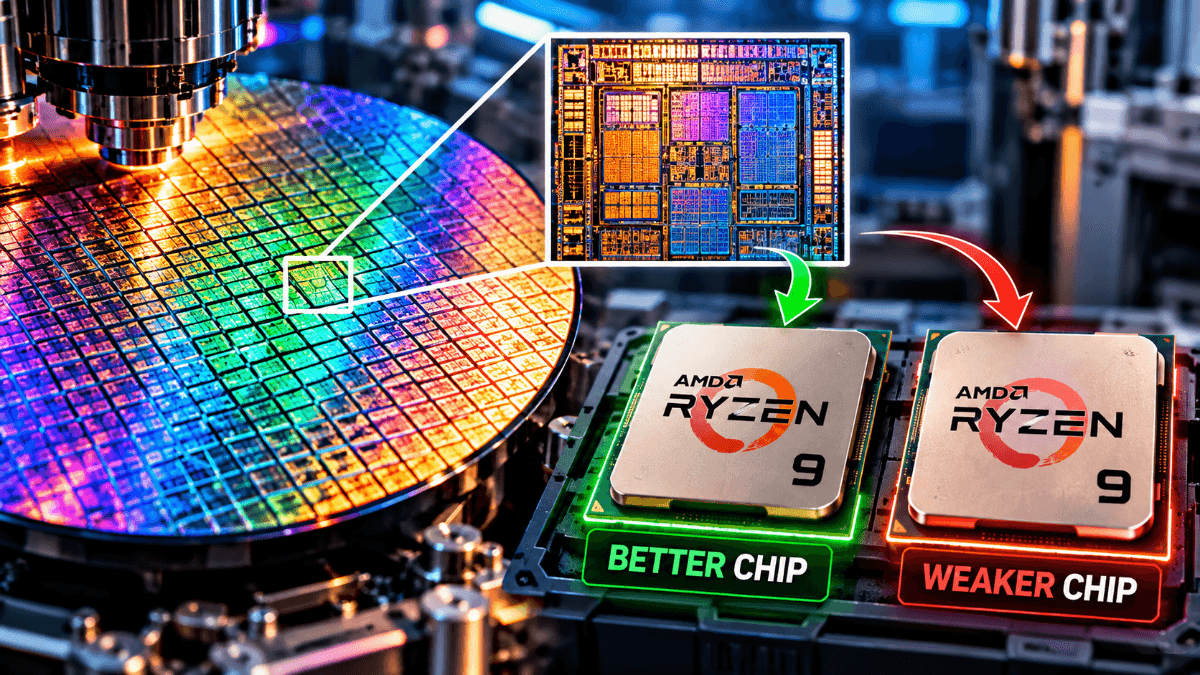
Imagine buying two AMD Ryzen 9 processors with exactly the same model number. Both come from the same manufacturer, have identical specifications on the box, and cost the same amount of money.
But when you push them to their limits, something surprising happens.
One processor runs at a higher clock speed with less voltage, produces less heat, and offers better overclocking potential. The other requires more voltage to achieve similar performance and reaches its temperature limits much sooner.
How is that possible?
Are some processors simply born luckier than others?
Surprisingly, yes! This phenomenon is commonly known among PC enthusiasts as the Silicon Lottery. And the explanation begins at the microscopic level, inside the semiconductor manufacturing process.
How Are Processors Manufactured?
To understand why two identical CPUs can perform differently, we first need to understand how a processor is made.
Modern processors are manufactured using extremely pure silicon wafers inside highly controlled semiconductor fabrication facilities.
A single silicon wafer can contain hundreds of individual processor dies. Each die contains billions of microscopic transistors that work together to perform calculations, process instructions, and execute software.
These transistors are so incredibly small that thousands of them can fit within the thickness of a human hair, depending on the transistor dimensions and the manufacturing process.
Manufacturing at this scale requires extraordinary precision.
However, even with advanced manufacturing technology, producing perfectly identical chips is practically impossible.
Tiny variations in manufacturing materials, transistor characteristics, electrical resistance, and leakage current can create differences between individual dies.
And these microscopic differences can influence how efficiently a processor operates.
Why Are Two Identical CPUs Not Always Equally Powerful?
Here's where things get interesting.
Imagine two processors manufactured from the same silicon wafer.
Both have the same architecture and are designed to meet identical specifications. However, their electrical characteristics may be slightly different.
For example:
One processor may achieve a particular clock speed using relatively low voltage.
Another may require more voltage to maintain the same clock speed.
One may generate less heat under similar operating conditions.
Another may reach its thermal or power limits sooner.
These differences don't necessarily mean that one processor is defective.
Both chips can pass the manufacturer's quality tests and operate perfectly within their advertised specifications.
However, their performance potential beyond those guaranteed specifications may be different.
This is the foundation of what PC enthusiasts call the Silicon Lottery.
What Is CPU Binning?
Manufacturers cannot simply assume that every processor coming out of a fabrication facility will have identical electrical characteristics.
That's why processors go through testing and classification.
This process is called CPU binning.
During binning, manufacturers evaluate processors against specific product requirements, including:
Performance and clock speed capabilities
Power consumption
Electrical characteristics
Thermal behaviour
Functional core configurations
Based on the results, processors are assigned to products with different specifications.
For example, certain processor families may use different core configurations or disable specific cores that fail validation or are not enabled in a particular product configuration.
This allows manufacturers to use silicon dies efficiently while creating products for different market segments.
However, it's important to understand that an Intel Core i9 is not necessarily just a better-quality version of an otherwise identical Core i7 or Core i5. Different product tiers can have different architectures, core counts, cache configurations, and specifications.
Similarly, AMD Ryzen 9, Ryzen 7, and Ryzen 5 processors aren't simply three quality grades of the same chip.
CPU binning is a broader manufacturing and product-classification process.
What Happens When Some CPU Cores Fail Testing?
Sometimes, a processor die contains multiple CPU cores, but one or more cores fail functional testing or cannot meet the required specifications.
Instead of discarding the entire die, manufacturers may disable the affected cores and sell the processor with a lower core configuration, provided it meets the requirements of that product.
Core disabling can be implemented through different hardware mechanisms, including fuses and other configuration methods.
This is one reason why some processors with different core counts can be based on related silicon designs.
However, not every lower-tier processor is created by disabling defective cores. Some are designed with different configurations from the beginning.
The important point is that manufacturers can use different portions of their available silicon to create products at different price points.
Why Can Two Ryzen 9 Processors Have Different Overclocking Potential?
Now comes the most interesting part of the Silicon Lottery.
Even two processors with the exact same model number can have different overclocking potential.
Let's imagine two identical Ryzen 9 processors.
Both are operating under the same motherboard, cooling system, and workload.
Processor A:
Maintains a particular clock speed at relatively low voltage.
Produces comparatively less heat.
Remains stable under demanding workloads.
Has more headroom for manual overclocking.
Processor B:
Requires more voltage for similar clock speeds.
Produces more heat under comparable conditions.
Reaches its power or temperature limits sooner.
Has less room for additional overclocking.
Both processors may still perform within the manufacturer's advertised specifications.
The difference becomes noticeable when enthusiasts try to push them beyond their normal operating conditions.
This is why buying an expensive processor doesn't guarantee that you'll receive an exceptional overclocker.
Sometimes, the cheaper or seemingly ordinary chip can have surprisingly good silicon characteristics.
What Is Extreme CPU Overclocking With Liquid Nitrogen?
Some hardware enthusiasts take this performance experiment to an entirely different level.
They use a cooling technique called Liquid Nitrogen (LN2) cooling to achieve extremely low temperatures during experimental overclocking sessions.
Liquid nitrogen boils at approximately -196°C under atmospheric pressure.
During extreme overclocking, enthusiasts use specially designed copper cooling pots mounted on the processor. Liquid nitrogen is carefully added to these pots to remove heat generated by the CPU.
This allows experienced overclockers to experiment with clock speeds far beyond normal operating conditions.
However, extreme overclocking requires specialised hardware, careful voltage control, insulation, and extensive technical knowledge.
It is not a normal everyday cooling method.
And even with liquid nitrogen, not every processor can achieve the same clock speed.
The silicon lottery still matters!
Can You Win the Silicon Lottery?
If you're buying a new processor, you might wonder whether there's a way to identify a particularly good chip.
Unfortunately, the model number and retail packaging generally won't tell you how good its individual silicon characteristics are.
You can compare:
Real-world CPU benchmarks
Power consumption under load
Temperature behaviour with comparable cooling
Overclocking results from reliable reviewers
But you generally cannot know the exact overclocking potential of an individual processor before testing it.
That's what makes the Silicon Lottery so interesting.
Two processors can have the same brand, model number, specifications, and price tag, yet behave differently when pushed beyond their guaranteed operating limits.
Final Thoughts: Same Processor Doesn't Always Mean Identical Performance
Modern CPU manufacturing is an extraordinary achievement.
Billions of microscopic transistors work together inside a tiny piece of silicon, and even incredibly small manufacturing variations can influence electrical characteristics.
CPU binning helps manufacturers classify processors according to their capabilities, while the Silicon Lottery describes the unpredictable differences enthusiasts discover when comparing individual chips.
So, the next time you see two identical Ryzen 9 processors performing differently under extreme overclocking, remember:
They may have the same name, the same specifications, and the same price, but their silicon isn't necessarily identical.
In the world of processors, being identical twins doesn't always mean having identical abilities.
Frequently Asked Questions10 FAQs
Quick answers to common questions about this topic
The Silicon Lottery refers to the natural variation in electrical characteristics between processors of the same model. Some CPUs can achieve higher clock speeds with less voltage, while others may require more power and produce more heat.
Two identical CPUs can have slightly different transistor characteristics, leakage currents, and voltage requirements. Cooling, motherboard settings, power limits, and system configuration can also cause performance differences.
CPU binning is the process manufacturers use to test and classify processors based on their performance, power consumption, electrical characteristics, and functional core configurations.
Not necessarily. Core i9 and Core i7 processors can have different architectures, core counts, cache sizes, and specifications. A higher-tier model doesn't automatically mean every individual chip has better silicon characteristics.
They are designed to meet the same advertised specifications for their particular model, but individual processors can differ in voltage requirements, thermal behaviour, and overclocking potential.
Manufacturers may disable cores that fail functional testing or do not meet specific product requirements. They may also disable otherwise functional cores for product segmentation. This allows manufacturers to create processors with different core configurations.
No. Many lower-tier processors are designed with fewer cores from the beginning. Some products use dies with disabled cores, while others have different physical configurations.
CPU binning is an official manufacturing and classification process performed by manufacturers. Silicon Lottery is an informal term used by PC enthusiasts to describe the unpredictable differences in individual chip quality and overclocking potential.
Liquid nitrogen cooling is an extreme cooling technique used by professional overclockers and enthusiasts. Liquid nitrogen, which boils at approximately -196°C at atmospheric pressure, is used in specialised cooling pots to remove heat from processors during extreme overclocking experiments.
No. Liquid nitrogen can help reduce thermal limitations during extreme overclocking, but it cannot guarantee higher clock speeds. Every processor has electrical and architectural limitations, and extreme overclocking also introduces additional risks.