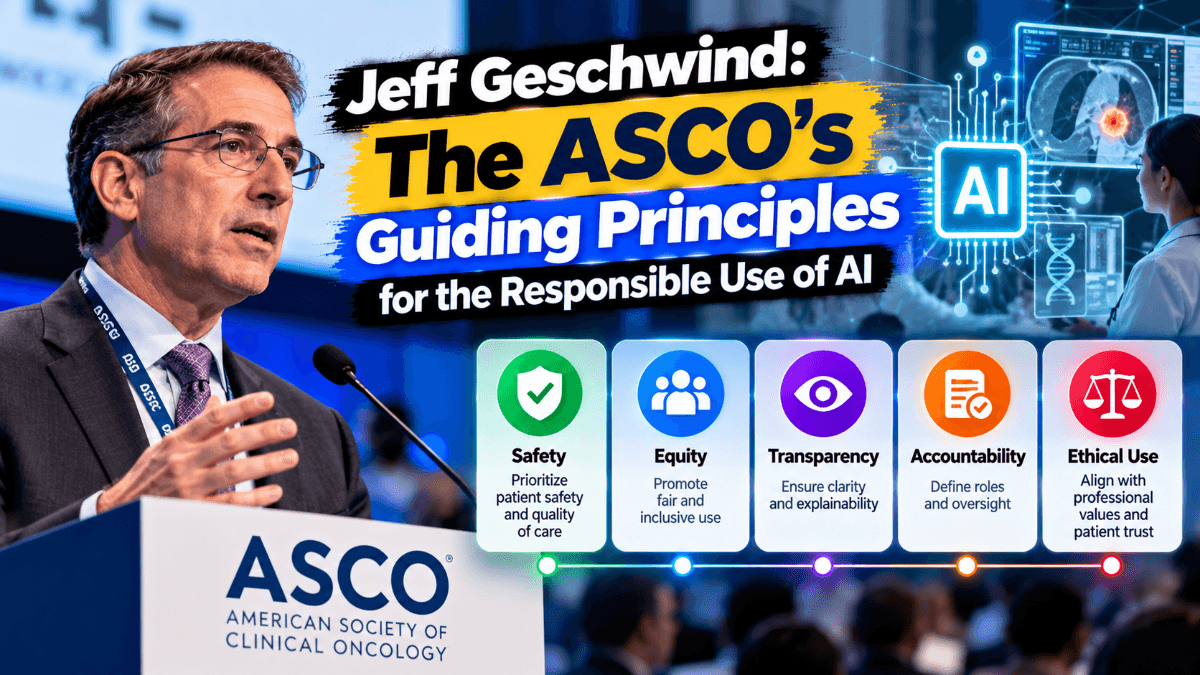
Jeff Geschwind, MD, is an interventional oncologist widely recognized as a world expert on liver cancer, serving as Medical Director of Oncology, Image-Guided Therapy, and Imaging Core Lab at NAMSA, a leading contract research organization. He also serves as a Medical Advisor for HistoSonics, developing non-invasive, ultrasound-based cancer therapies, and consults for Philips Healthcare and Cage Pharma, a cancer drug company he founded in 2009. Dr. Geschwind has led more than 50 clinical trials and previously held professorships at Johns Hopkins University, directing interventional radiology for nearly 15 years, and at Yale University School of Medicine, where he chaired the Department of Radiology and Biomedical Imaging. He pioneered the use of cone beam CT imaging to guide liver tumor treatment, now the standard of care for intra-arterial therapies. His decades of oncology leadership give him a close vantage point on how ASCO is shaping guidelines for the responsible use of artificial intelligence in cancer care.
The American Society of Clinical Oncology (ASCO) has served as a world-leading professional organization for physician/scientists and other oncology professionals involved in the care of patients with cancer since 1964. The ASCO maintains a depth of resources and tracks the latest oncology news, in addition to advocating for important policies and initiatives that impact the field of oncology.
For years, the organization has promoted the responsible use of artificial intelligence (AI) and technology that can assist oncology professionals and advance cancer care. In 2024, ASCO formalized the organization’s position on AI technology by developing its Guiding Principles for the Responsible Use of AI.
Together, these six principles form a clear, actionable framework designed to guide members of the oncology community through safe AI practices that benefit both patients living with cancer and the clinical professionals who care for them.
First, ASCO calls for consistent and complete transparency when it comes to the use of AI tools and applications in clinical settings. AI technology should remain transparent throughout its life cycle, allowing users to assess, criticize, validate, and optimize the quality and function of AI-powered processes.
A Journal of American Medical Association survey echoed these sentiments, with approximately 85 percent of US oncologists stating that oncologists should be able to explain how AI works and over 81 percent agreeing that patients should have the opportunity to consent to the use of AI during cancer treatment.
Next, AI requires informed stakeholders, meaning that clinicians and patients should be fully aware of when AI is informing clinical decision-making processes and patient care services. With this guideline in mind, ASCO has called for more educational materials that inform clinicians on how AI collects and uses data to make clinically impactful decisions.
Understanding how AI influences decision-making can strengthen a facility or practitioner’s approach to informed consent.
Fairness and equity are paramount to the effective use of AI in clinical oncology environments. Medical professionals must ensure that AI developers have taken steps to prevent biases from compromising AI model design, and must also evaluate their own biases while using AI tools and platforms.
Accountability is critical to the effective implementation of AI systems in health care. All AI tools and applications need to comply with legal, professional, and ethical standards, particularly those that regulate the use of data. Developers and users are equally responsible for how AI systems adhere to these and other requirements.
One of the most sensitive aspects of AI regulation involves the security of private data. Clinicians and policymakers must work together to develop organizational compliance standards that detail protections that protect personal health information.
AI demands huge volumes of patient data to remain effective, meaning developers and users must simultaneously invest in the creation and implementation of privacy-enhancing technologies to ensure that this data remains anonymous and secure.
Finally, everyone involved in the development and use of AI in oncology settings must remember that they are engaging in the human-centered application of an emerging technology. The express purpose of integrating AI capabilities with existing oncology technologies and practices is to better serve medical professionals and improve patient outcomes.
Even after following these guiding principles for the ethical and effective use of AI, human interaction will remain a fundamental element of health care delivery. AI cannot eliminate the need for human engagement in medicine, only enhance it.
ASCO leaders recognize that AI is a rapidly developing field of technology. With this in mind, they have reviewed and updated the Guiding Principles for AI in Oncology several times. The latest version of the framework is always available to read at asco.org.
About Jeff Geschwind
Jeff Geschwind, MD, is an interventional oncologist and widely recognized expert on liver cancer. He serves as Medical Director of Oncology, Image-Guided Therapy, and Imaging Core Lab at NAMSA and as a Medical Advisor for HistoSonics, while also consulting for Philips Healthcare and Cage Pharma, a company he founded. He previously held professorships at Johns Hopkins University and Yale University School of Medicine. Dr. Geschwind earned his MD from Boston University School of Medicine and has led more than 50 clinical trials.