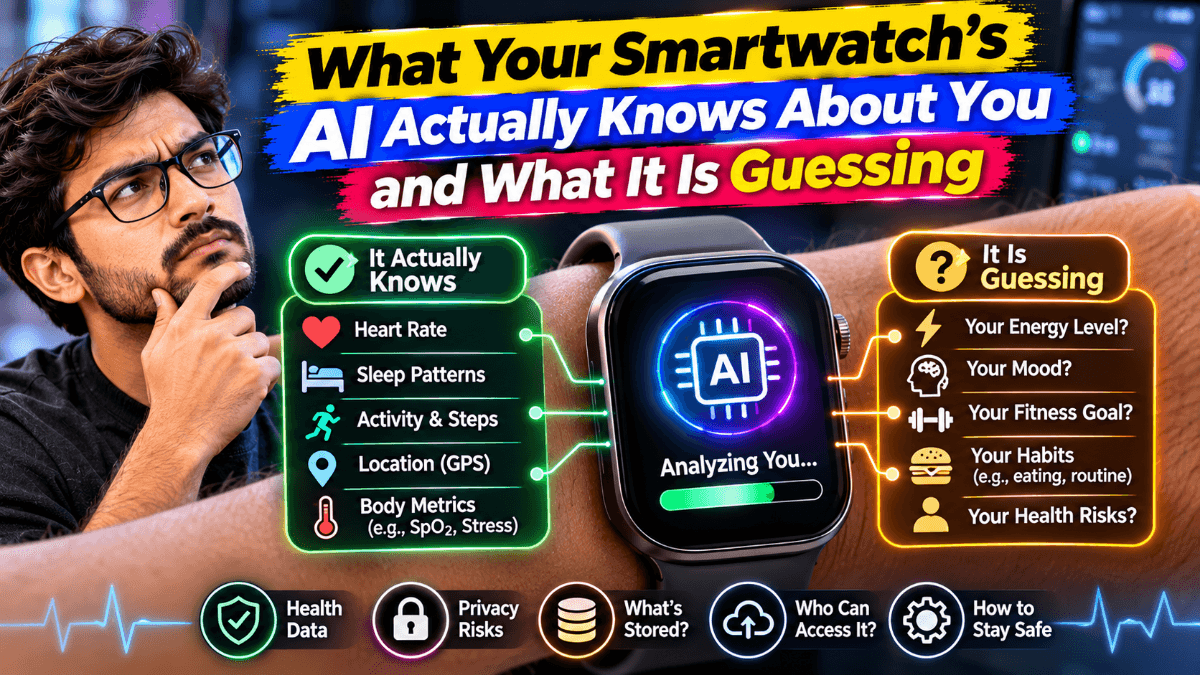
Smartwatch marketing has quietly shifted vocabulary. A few years ago, watches "tracked" your heart rate and steps. Now they offer "AI-powered sleep coaching," "intelligent recovery scores," and "smart health insights." The hardware on your wrist has improved, but much less than the language around it. Most of what a modern watch tells you is not measured directly — it is inferred by software from a small number of sensors.
That is not a criticism. Inference is useful, and some of it is very good. But knowing which numbers are close to a measurement and which are an educated guess changes how you should read them, and which features are worth paying for. This guide walks through the main sensors, what the algorithms on top of them can and cannot do, and how to use that knowledge when choosing a watch.
The sensors are fewer than you think
Strip away the software and most smartwatches carry the same short list of hardware:
- An accelerometer and gyroscope — they detect movement and orientation. Steps, workouts, fall detection, and a large part of sleep tracking all start here.
- An optical heart-rate sensor (PPG) — LEDs shine into the skin and photodiodes measure how much light is reflected back. Blood volume changes with each heartbeat, and that rhythm becomes your pulse.
- Red and infrared LEDs on many models — used to estimate blood oxygen (SpO2).
- Electrodes on some models — used for a single-lead ECG when you touch the crown or bezel with your other hand.
- A skin temperature sensor on newer models.
- GPS, barometer, and microphone, depending on the model.
Every "AI" feature is a model that turns signals from this list into a statement about your body. The quality of the statement depends on two things: how clean the raw signal is, and how directly the signal relates to what is being claimed.
Heart rate: a measurement, with conditions
Wrist heart rate is the closest thing a smartwatch has to a true measurement. At rest and during steady activity like walking or easy running, optical sensors from major brands track pulse well. Independent laboratory comparisons have repeatedly found wrist heart rate to be reasonably accurate in those conditions.
The problems appear when the signal gets noisy:
- Fast changes in intensity. During intervals, weightlifting, or anything with a lot of wrist movement, the sensor can lag behind or lock onto your cadence instead of your heartbeat.
- Fit. A loose strap lets ambient light in and lets the sensor move against the skin. Wearing the watch a finger's width above the wrist bone and snug during workouts makes a visible difference.
- Skin and tattoos. Ink and some skin conditions change how light is absorbed, which can degrade readings.
If your training depends on precise heart-rate zones, a chest strap that measures electrical activity is still more reliable than any wrist sensor. For daily resting heart rate and general activity, the watch is good enough — and resting heart rate trends over weeks are among the most useful numbers it produces.
Blood oxygen: a trend, not a diagnosis
SpO2 on a watch uses the same optical principle as a fingertip pulse oximeter, but under worse conditions: the wrist has less blood flow near the surface, and the watch is rarely perfectly still. Most manufacturers label their SpO2 features as wellness tools rather than medical devices in many markets, and that label is accurate.
Use blood-oxygen readings as a trend to notice, not a number to act on. A consistent pattern of low overnight readings is a reason to talk to a doctor, not proof of anything. A single odd spot-check reading usually means the watch moved.
Sleep tracking: good at "asleep or awake," weaker at stages
Sleep tracking is where "AI" language is most common, and where the gap between marketing and reality is largest.
The gold standard for sleep measurement is polysomnography: a lab test that records brain waves, eye movement, muscle activity, and breathing. A watch has none of those signals. It estimates sleep from movement, heart rate, and heart-rate variability, and then a model classifies each segment of the night.
Comparison studies against polysomnography show a consistent picture:
- Watches are good at detecting that you are asleep.
- They are weaker at detecting brief awakenings, so they tend to overestimate total sleep time.
- Sleep-stage breakdowns (light, deep, REM) agree with lab results only moderately. The night-to-night stage numbers are best treated as rough estimates.
The practical takeaway: bedtime consistency, total sleep duration over a week, and overnight resting heart rate are worth watching. A "deep sleep dropped 12 minutes" message is not worth worrying about.
ECG and irregular rhythm alerts: narrow, but real
This is the part of smartwatch health tracking that has earned regulatory clearance in several countries. A single-lead ECG on a watch can record a heart rhythm strip and flag signs of atrial fibrillation (AFib), a common irregular rhythm that raises stroke risk.
The background irregular-rhythm notifications — where the watch passively checks your pulse pattern using the optical sensor — have also been studied at scale. The Apple Heart Study, published in the New England Journal of Medicine in 2019, enrolled more than 400,000 participants and found that a meaningful share of people who received a notification and later wore an ECG patch did have AFib.
Two important limits:
- A single-lead watch ECG does not detect heart attacks and does not replace a 12-lead ECG at a clinic.
- Clearance applies to a specific feature in a specific country. A watch sold globally may have the ECG app disabled in your region.
If heart-rhythm monitoring is a reason you are buying, check that the feature is available and cleared where you live before you buy.
Calories and "readiness" scores: the least reliable numbers
Calorie burn is the number people trust most and should trust least. A widely cited 2017 Stanford study tested seven wrist devices and found that heart rate was measured fairly accurately by most of them, but energy expenditure estimates were off by more than 20% for every device tested. Calories are calculated from heart rate, movement, and your profile data, and the model has no way to measure your actual metabolism.
Composite scores — "body battery," "readiness," "recovery" — are built on top of heart-rate variability, resting heart rate, sleep estimates, and recent activity. They can be useful as a personal signal over time, especially when they move in the same direction as how you feel. But they are each brand's own formula, they are not comparable between brands, and none of them is a medical measurement. Treat them as a nudge, not a verdict.
Where AI genuinely helps
None of this means the software is marketing fluff. Machine learning is doing real work in several places:
- Noise filtering. Separating your pulse from wrist motion is a hard signal-processing problem, and better models are a large part of why newer watches track heart rate more reliably than older ones with similar sensors.
- Pattern detection over long periods. A model can notice that your resting heart rate has been elevated for four days or that your skin temperature has shifted, which you would never see by looking at daily numbers.
- Event detection. Fall detection, irregular rhythm alerts, and newer breathing-disturbance notifications during sleep are classification problems that models handle well when trained on large datasets.
- Coaching interfaces. Newer assistants turn raw data into plain-language summaries. They are only as good as the underlying measurements, but they lower the effort of actually using the data.
How to choose a smartwatch with this in mind
When you compare models, the spec sheet tells you more than the feature names. A few questions cut through most of the noise:
- Which sensors are actually listed? If a watch claims blood-oxygen tracking, it should list red/infrared LEDs. If it claims ECG, it needs electrodes. Features built on missing hardware are pure estimation.
- Is the health feature cleared in your country? Look for the specific feature, not the brand in general.
- Does it work with your phone? Some watches only fully work with one phone ecosystem. Check compatibility before comparing anything else.
- What does battery life look like with the features you will use? Always-on display, continuous SpO2, and GPS workouts can cut battery life dramatically compared with the headline figure.
- Are the insights behind a subscription? Some brands put trend analysis and coaching behind a monthly fee. Factor that into the price.
- Can you export your data? If you change brands later, being able to take years of heart-rate and sleep history with you matters.
It helps to look at listings side by side rather than one product page at a time. If you want to compare smart watches by their listed sensors and features, a catalog that shows specifications next to each other makes it much easier to spot which models actually have the hardware behind the claims.
The short version
A smartwatch is a capable trend tracker and, for a few specific features, a genuinely useful health screening tool. It is not a medical device in most of what it reports, and the word "AI" on the box does not change the sensors inside it.
Trust resting heart rate, activity, and sleep duration trends. Treat sleep stages, calories, and readiness scores as estimates. Take irregular rhythm alerts seriously and follow up with a doctor. And when you choose a watch, start from the sensor list and regional feature availability rather than from the marketing name of the feature. That way, the numbers on your wrist work for you instead of the other way around.