Most of us carry a wallet full of loyalty cards and a phone full of points we never use. Brands think they're doing a great job, but members often see it differently. In one industry study, 83% of marketers said they make members feel valued, while only 56% of consumers agreed (Antavo).
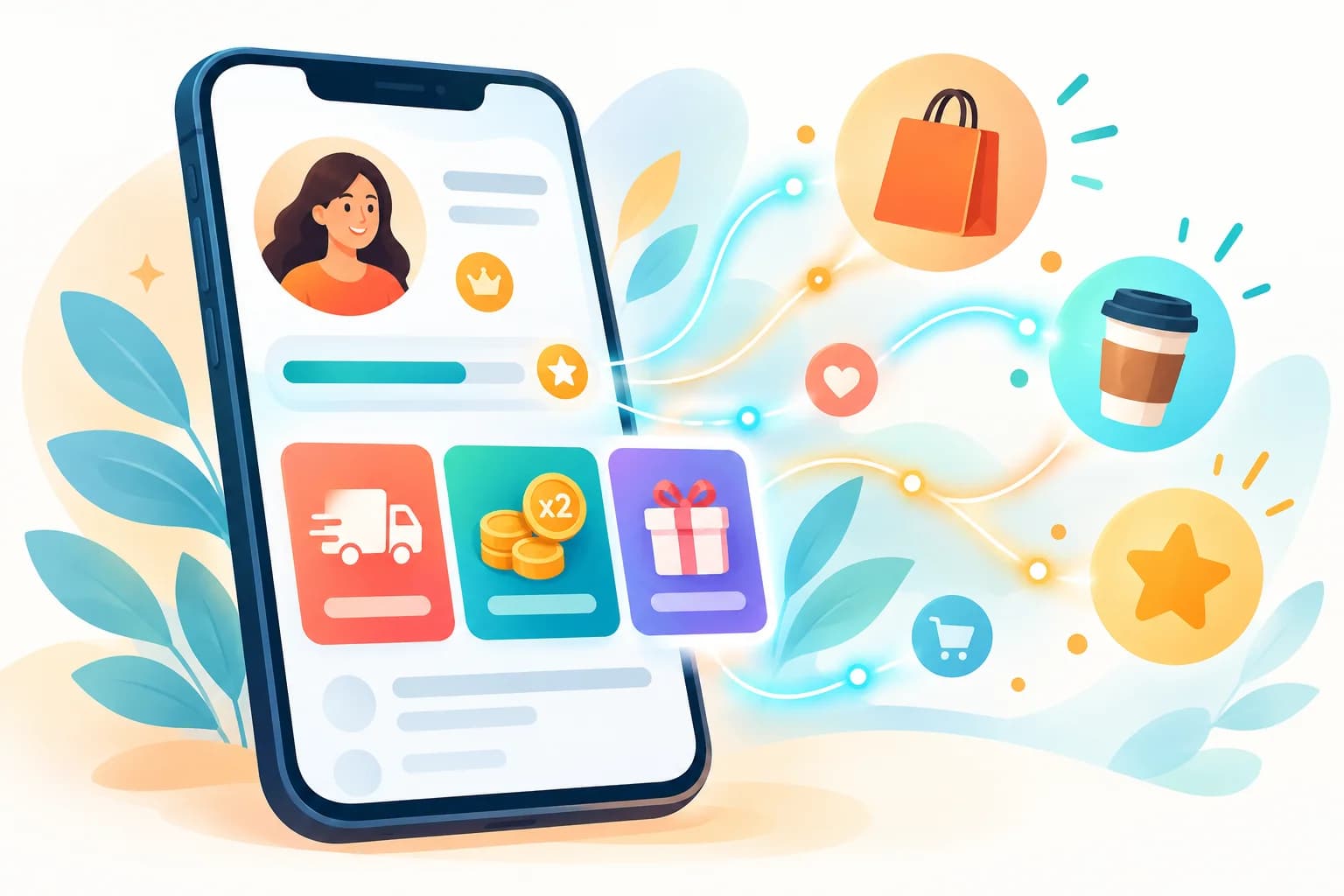
AI-powered loyalty programs try to close that gap. An AI-powered loyalty program uses machine learning to study each member's habits, then picks the reward, the timing, and the message that fit that one person. Instead of the same coupon for everybody, members get something that feels made for them. In this guide, you'll see how it works, who does it well, and how to start without burning your budget.
Why Generic Loyalty Rewards Are Failing
Why flat points no longer excite most members
Flat points worked fine back when a punch card felt special. You bought ten coffees, got one free, and everybody went home happy. Today, people juggle a ton of memberships, and most of them collect dust. One 2026 roundup found 17.4 total memberships per person but only 8.8 that people actually use (Access Development). Another source says 65% of consumers do not engage with every program they have joined (NCR Voyix).
The gap between what brands think and members feel
Remember the 83% versus 56% gap? It tells you that a lot of teams are guessing. Nearly 3 in 4 consumers told Deloitte Digital they want personalized loyalty rewards, and those rewards ranked right behind money-saving offers on their wish list. So people are asking for it out loud, plain and simple.
The hidden cost of one-size-fits-all rewards
A reward that misses the mark costs you twice. You pay for the discount, and the member still ignores it. Picture a vegan shopper who gets a steak coupon. That person feels unseen, and unseen customers tend to drift away without saying a word. At the end of the day, a generic reward is often just an expensive way to send the wrong message.
What AI-Powered Loyalty Programs Actually Are
AI loyalty programs vs. traditional points systems
A traditional program follows fixed rules and treats everyone the same. An AI-powered program looks at what each person really does, such as how often they buy, what they browse, and which rewards they redeem, and then it adjusts (Extole). Here's how the two stack up.
- Rewards: the same list for everyone (traditional) vs. picked for each member (AI)
- Earning rules: fixed points per dollar vs. rates that can shift with behavior
- Timing: scheduled email blasts vs. messages triggered by what the member does
- Tiers: bronze, silver, gold by spend vs. tiers that adapt over time
- Support: a help desk with office hours vs. assistants that answer any time
- Improvement: manual reports vs. ongoing testing and learning
What hyper-personalization really means for rewards
Hyper-personalization is a lot more than putting a first name in an email subject line. It means using real behavior to shape what a member sees next. One loyalty vendor, Growave, describes it as using data to show customers you were listening. That sums it up nicely.
The segment of one idea explained simply
For years, brands sorted people into groups like students, parents, or big spenders. A segment of one skips the group and treats each person as their own bucket. AI can even weigh context such as weather, location, and time of day to guess what someone will want next (TRIFFT). It's a big step up from "everyone aged 25 to 34."
Data that fuels personalized loyalty programs
AI is only as good as the data you feed it. Clean data matters because it keeps offers relevant (Forbes Business Council). Here are the main data types most programs use:
- Purchase history and how often someone buys
- Browsing habits and wishlist items
- Which rewards a member redeems, and which they skip
- Email and app activity
- Context, such as time of day and location
The best programs lean on first-party data, which is information members share directly with you. Competitors can't copy that, and that's a big deal (Paytronix).
How AI Personalizes Rewards Step by Step
Under the hood, most systems run a simple loop. They watch behavior, guess what a member wants, act on that guess, and learn from the result (Cprime). Then the loop starts again. Let's walk through the parts that members actually notice.
Learning from purchases, browsing, and redemptions
Every click and purchase tells the system something. If a member always redeems free shipping and never touches product discounts, the system learns that fast. It stops wasting offers on things that person ignores. No big deal for the member, but a real saving for the brand.
Predicting the next purchase and the next reward
Here's where it gets fun. Say a customer buys coffee beans about every 30 days. The program can send a restock reminder on day 28, maybe with a small points bonus for finishing the order (Growave). One retail example describes Target's AI forecasting when a member will buy next and what they'll want (Nector).
Choosing the right reward, channel, and moment
The best offer at the wrong time still flops. AI can decide whether a member sees a push notice, an email, or an in-app card, and when. Real-time tools deliver content based on what the customer is doing right now (Netguru). Think of it as sending the right message at the right hour, not just any message.
Dynamic point earning based on member behavior
In most programs, everyone earns points at the same flat rate. A hyper-personalized program can change that rate based on how a person shops. Brandmovers calls this "surge" accumulation, and says it works because of two ideas from behavioral science: the endowed progress effect and variable reward schedules. In plain words, people push harder when they feel they've already started, and when the next reward is a bit of a surprise.
Here's a tiny example of the idea in Python. It's a simple rule, not a trained model, but it shows how earning rates can react to behavior:
def points_for_order(order_total, days_since_last_order, is_new_member): """Return loyalty points for one order.""" rate = 1.0 # base: 1 point per dollar if is_new_member: rate = 2.0 # welcome boost for the first 90 days elif days_since_last_order > 60: rate = 1.5 # win-back nudge for members who went quiet return round(order_total * rate) print(points_for_order(40, 75, False)) # 60 pointsReward catalogs that change for each member
A static catalog shows the same choices to everyone, so it appeals to nobody in particular (TRIFFT). A personal catalog puts the right options at the top for each person. Some brands even let members build their own rewards, like Sephora, which lets customers tailor makeup bundles to their skin and hair colors (Voucherify).
Behind the scenes, a personal catalog can be as simple as a ranked list stored for each member. This JSON sketch shows the shape:
{ "member_id": "m_10482", "top_rewards": [ { "reward": "free_shipping", "score": 0.91 }, { "reward": "double_points_weekend", "score": 0.74 }, { "reward": "early_access_new_arrivals", "score": 0.58 } ], "preferred_channel": "push", "best_send_hour": 18 }The scores come from a model that learns what each person redeems. The app then shows the highest-scoring rewards first.
Beyond Points: Engagement, Tiers, and Win-Backs
Personalized challenges, streaks, and missions
Points are only one way to keep people coming back. A mission that fits the member works even better. A shopper who mostly browses might get a small mission to write a first review, since reviews are a common way to earn rewards (Voucherify). A daily user might get a streak instead. The trick is matching the challenge to the habit, so it feels fun and not like homework.
Tiers that adapt instead of staying fixed
About 70% of brands that reward customers offer tiered benefits, and 42% of those use AI or machine learning to make the tiers more personal (Antavo). That means a gold member and a silver member can still see very different perks. Tiers stop being a ladder and start acting more like a map.
Win-back offers triggered by churn signals
AI can spot the early signs that a member is fading, like fewer visits or unopened emails (Loyalty Levers). Then it can send a nudge before the person is gone for good. One vendor report claims predictive analytics can cut churn by 30%, though results will vary by business (Netguru). Treat that number as a target to test, not a promise.
AI assistants that explain perks and benefits
Let's face it, many members have no clue what their program offers. AI assistants can help by answering questions, suggesting rewards, and handling redemptions at any hour (Netguru). Some are also built to point out perks before the member even goes looking (AdvantageClub).
Real-World Examples of Hyper-Personalized Loyalty
How Starbucks uses AI to tailor member offers
Starbucks is the go-to example. Its Deep Brew platform uses data and AI to build personal offers for specific groups of rewards members (Voucherify). In the first quarter of 2024, the program reached 34.3 million active U.S. members over 90 days, up 13% from the year before (same source). A Forrester analyst says the company uses AI to spot and reward specific members with tailored offers (CX Dive).
Sephora-style choice in rewards and bundles
Sephora lets customers customize reward bundles to match their own hair and skin colors (Voucherify). It's a small touch, but it says "we know you." You don't need a huge AI team to borrow the idea. Even a short quiz at sign-up can be a start.
Examples from fintech, gaming, and e-learning
Most case studies come from retail and coffee, so here are ideas to borrow in other fields. These are starting points, not proven case studies, so test them on a small group first.
- Fintech: rewards tied to each customer's real spending and savings goals. It feels useful, not random.
- Gaming: quests matched to a player's style, such as casual or competitive. It keeps play fresh.
- E-learning: streaks and badges set to each learner's pace. It rewards effort, not just speed.
- Streaming: watch challenges based on favorite genres. It points people to what they'll enjoy.
What Personalization Does for Business Results
Higher enrollment and stronger retention
People like the idea of AI in loyalty. In Antavo's 2025 survey, 39.6% of consumers said they'd be more likely to join a program that uses AI. Younger shoppers lean in even more, with 55% of Gen Z and 53% of Millennials saying the same (Access Development). Paytronix points out that lifting a repeat rate from 30% to 40% can change your business economics.
Bigger baskets and higher lifetime value
McKinsey research, as reported by Extole, says companies that excel at personalization earn 40% more revenue from those activities than average ones. One vendor report says members of personalized programs spend 37% more (Bubblehouse). Vendor numbers can run rosy, so check them against your own data. Still, 93% of program owners who track ROI report positive returns, averaging 5.3X (Antavo).
Quick stats at a glance:
- 39.6% of consumers are more likely to join an AI-powered program (Antavo)
- 55% of Gen Z and 53% of Millennials are more likely to join (Access Development)
- 40% more revenue for personalization leaders (Extole, citing McKinsey)
- 93% of ROI-tracking owners report positive returns, at 5.3X on average (Antavo)
- 51% of program owners offer AI-driven personalization (Antavo)
How to Launch Your First AI Loyalty Program
You don't need a giant budget to get going. You do need a plan, so here are five steps in a sensible order.
Audit your data and fix broken data silos
Start by looking at what you already have. Many shops run separate tools for loyalty, reviews, and wishlists, and those tools don't talk to each other. That makes personalization nearly impossible, because the loyalty system can't see what's on a wishlist (Growave). Connect the pieces before you buy anything fancy.
Pick one clear goal before choosing any tool
Decide what success looks like. Maybe you want more repeat orders, or fewer members going quiet after 60 days. Pick one. A tool bought without a goal is a shiny toy that nobody plays with.
Start with two or three small AI use cases
A Forrester analyst advises brands to build use cases with clear, measurable value first, such as personalization, segmentation, variant testing, and low-code campaign building (CX Dive). Pick two or three and skip the rest for now. Small wins are easier to prove and easier to fix.
Focus on the first 90 days after sign-up
This is the step most guides skip. Paytronix says the 90 days after enrollment is where loyalty is either built or lost, and the gap between joining and becoming a regular is the most costly one. So make the first three months count. A welcome mission, a first reward that's easy to reach, and a check-in offer on day 30 are a good place to begin.
Test, measure, and improve every single month
Set a monthly rhythm. Change one thing, watch the numbers, and keep what works. AI-powered A/B testing can keep tuning reward structures in the background, but a person still has to decide what counts as a win (Netguru).
Quick launch checklist:
- Data sources connected and cleaned
- One primary goal written down
- Two or three use cases chosen
- A 90-day welcome journey drafted
- Consent and privacy wording reviewed
- A monthly test schedule on the calendar
Privacy, Trust, and Knowing When Not to Use AI
Ask for consent and explain the value clearly
Members share data when they see what's in it for them. Show how sharing leads to better recommendations, exclusive offers, and improved rewards, and put data security first (TrueLoyal). Use plain words on your sign-up screen. If a tactic feels creepy, it probably is, so err on the side of less (Brandmovers).
Give members control over their own data
Let people see what you know and change it. A simple preference page, where members pick their favorite categories or turn off certain messages, goes a long way. Control builds trust, and trust keeps people in the program. It's also a smart way to collect data that people hand over willingly.
Cases where simple rules beat AI loyalty tools
Not every problem needs AI. One loyalty expert calls forcing AI onto problems that cheaper, conventional fixes could solve a big pitfall (CX Dive). A birthday reward, a welcome bonus, and free shipping over a set amount are all fine as plain rules. Save the AI for jobs where the choices really are too many for a person to sort out.
How to Measure Whether Personalization Works
Core KPIs: repeat rate, redemption, and churn
If you can't measure it, you can't fix it. Track a small set of numbers each month, and compare them with the same period last year so seasons don't fool you.
- Repeat purchase rate: shows whether members come back. Watch for holiday spikes.
- Reward redemption rate: shows whether rewards feel worth claiming. Watch for rewards that are too easy or too hard.
- Churn rate: shows how many members go quiet. Define "quiet" the same way each month.
- 90-day active rate: shows whether new members become regulars. Watch for small sign-up batches.
- Average order value: shows whether offers lift basket size. Watch for discounts that only shift timing.
- Program ROI: shows whether the program pays for itself. Don't leave out staff and tool costs.
Holdout groups and simple A/B tests for proof
A holdout group is a slice of members, say 10%, who keep getting the standard offers. Compare them with the personalized group and you'll see what AI actually added. Without a holdout, you can't tell whether sales rose because of your program or because it was a good month. It's the cheapest way to get a straight answer.
You can set up a holdout in a few lines of code. Hashing the member ID keeps each person in the same group every time:
import hashlib def assign_group(member_id, holdout_pct=10): """Return 'holdout' or 'personalized' for a member.""" bucket = int(hashlib.md5(member_id.encode()).hexdigest(), 16) % 100 return "holdout" if bucket < holdout_pct else "personalized" print(assign_group("m_10482"))Later, compare repeat rate and average order value between the two groups.
Reading results without fooling yourself
Be careful with early wins. A new offer often gets a bump just because it's new. Small groups can swing wildly by chance, and one lucky week proves nothing. Give tests enough time and enough members, write down your guess before you start, and be ready to hear "no effect." That answer is still useful.
Where AI Loyalty Programs Are Heading Next
Agentic AI and proactive rewards for members
Today's tools mostly react to what a member does. As agentic AI matures, programs may get more proactive and point out valuable perks before a customer even starts looking (AdvantageClub). Imagine an assistant that says, "You're two purchases from your next tier, and here's the easiest way to get there." That's the direction things are moving.
Invisible loyalty and emotional connection
Some trend watchers expect the best programs to stop feeling like programs at all (TRIFFT). Rewards simply show up when they matter. There's a shift from purely transactional deals toward emotional ones, but practical benefits still count, and winning brands find the balance (Netguru). In a nutshell, people want to feel known, and they still like a good deal.
Conclusion and Next Steps
Generic rewards made sense when data was scarce. Now that brands can see what each member does, sending everyone the same offer is a missed chance. Start small: fix your data, pick one goal, test two or three personal touches, and measure them against a holdout group. If you'd like ready-made levels, badges, and personalized rewards, a gamified loyalty platform like Captain Up can be a starting point. Compare a few tools before you commit. Your first move this week can be as simple as auditing what data you already have.
Frequently Asked Questions6 FAQs
Quick answers to common questions about this topic
It's a rewards program that uses machine learning to study each member's behavior and then picks the offers, timing, and messages for that person. The goal is to replace one-size-fits-all rewards with ones that feel personal.
It looks at purchases, browsing, and redemptions, predicts what a member will want next, and then chooses the reward, channel, and moment. It can also change earning rates and reward catalogs for each person.
It means going beyond a name in an email. Real behavior and context shape the rewards, offers, and messages a member sees.
Traditional programs use fixed rules and treat everyone the same. AI programs adjust rewards, tiers, and timing based on what each member actually does.
Many brands report gains, and one vendor report claims predictive tools can cut churn by 30%. Results depend on your data and offers, so test against a holdout group to see your own numbers.
Start with clean, connected data. Then tailor a few things at a time, such as reward choices, earning rates, and win-back offers, and measure each change.