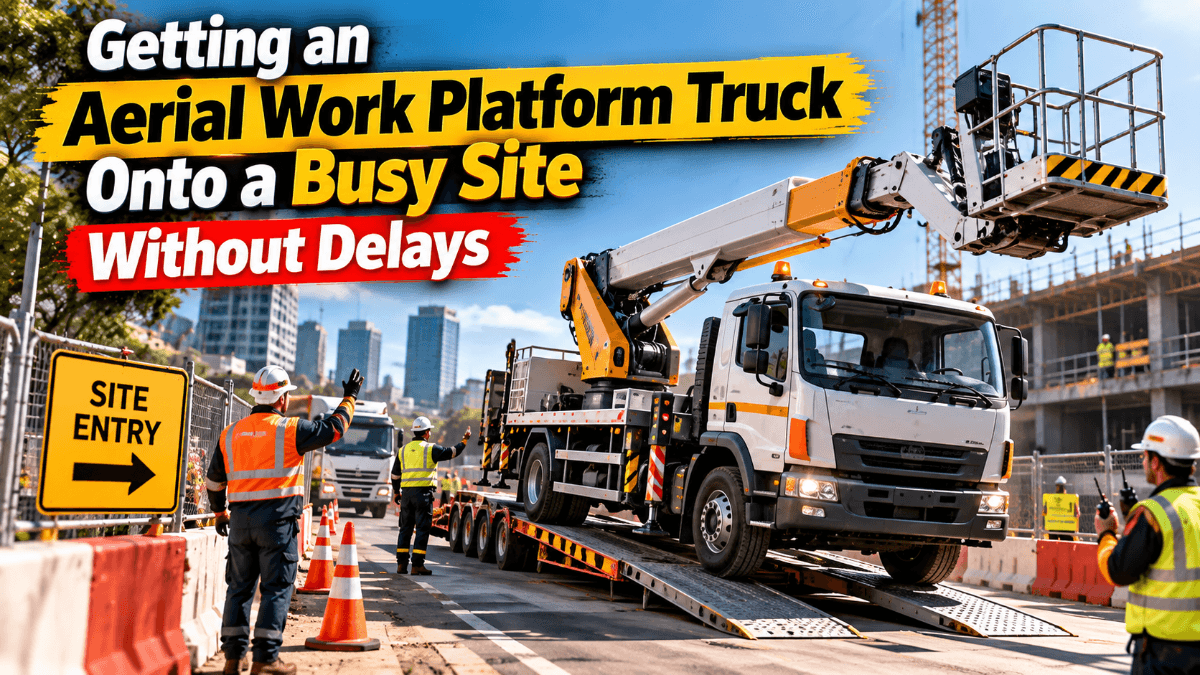
Aerial work platform truck delays are rarely mechanical. The machine turns up, the paperwork is fine, and the crew still loses three hours because a delivery is blocking the setup point and nobody can find the person with the key to the barrier.
Busy sites run on people, not plans. If you want the platform working by mid-morning, the useful preparation is a series of short conversations, each with someone who can stop the job.
The Site Manager: Agree a Window and a Position
A booking for a whole day tends to become a machine standing still. Ask for a specific arrival window, then ask what else is booked into it.
Two questions cover most of the risk. What other work is happening in that area, and who takes priority if the two clash? A concrete pour or a crane lift will outrank an access job every time, and moving your slot a week out is far easier than arguing about it in the morning.
Settle the setup position in the same call, then have it marked and kept clear. Ten minutes spent coning it off the evening before saves an hour of moving parked vehicles at eight.
Security and the Gatehouse: The Boring Detail That Stops Everything
Gate staff work to a list. If the driver, the operator and the vehicle registration are not on it, none of them come in, and no amount of urgency changes that.
Send names, vehicle details and arrival times ahead. Check whether inductions are required and whether they can be done online, because a two-hour induction at eight in the morning removes the best part of the working day.
Ask about the gate itself as well. Width, gradient, and any overhead restriction on the approach matter for a long chassis, and the answer often differs from the main entrance everyone describes by default.
Traffic and Pedestrians: Who Is Managing the Ground
Once the legs come down, the machine occupies space that people were walking or driving through an hour ago.
Settle who provides the traffic control plan, whether a flagger is needed, and how pedestrians are routed past the setup. If the platform overhangs a footway or a lane, that usually needs a permit from the local authority, and those are not same-day items.
The exclusion zone below the basket is part of this too. Tools drop. The area under the work has to be closed off, and someone has to keep it closed.
Other Trades: The Elevation Is Not Yours Alone
Two crews working the same facade at different heights is a genuine hazard, not just an inconvenience.
Find out who else is on that elevation and when. Scaffolders striking a tower, roofers loading materials, window fitters on a cradle: any of them can shut your work down for safety reasons, and all of them are easier to sequence a week out than on the day.
What an Aerial Work Platform Truck Supplier Needs From You
Delivery goes smoothly when the transport planner has a picture rather than a description. Send elevation photographs, the gate measurements, the agreed setup point, and the site contact's mobile number.
Providers hiring out an aerial work platform truck will also want to know the ground conditions at the setup position, because spreader pads are sized for the surface, and a yard that looks solid can hide a basement, a drainage run, or fresh backfill.
The Documents Worth Having Ready
Site-specific safety plan and job hazard analysis for the work at height
Operator certification and familiarization records for that model
Rescue plan for the platform in use
Permit to work, where the site operates one
Traffic control or footway permit, where the machine occupies public space
Proof of the pre-use inspection completed that morning
None of these take long to produce. All of them take a long time to produce at the gate with a crew standing around.
Where the Hours Are Really Won
The difference between a smooth arrival and a wasted morning is rarely the machine. It is whether five specific people knew what was coming and agreed to it in advance: the site manager, the gatehouse, whoever controls traffic, the other trades on that elevation, and the supplier's transport planner. Make those calls in the week before, not the night before. Suppliers such as Blade Platforms will work to an agreed window and a marked setup point if you give them one, so settle the access plan early and let the crew spend the day working at height rather than waiting at ground level.