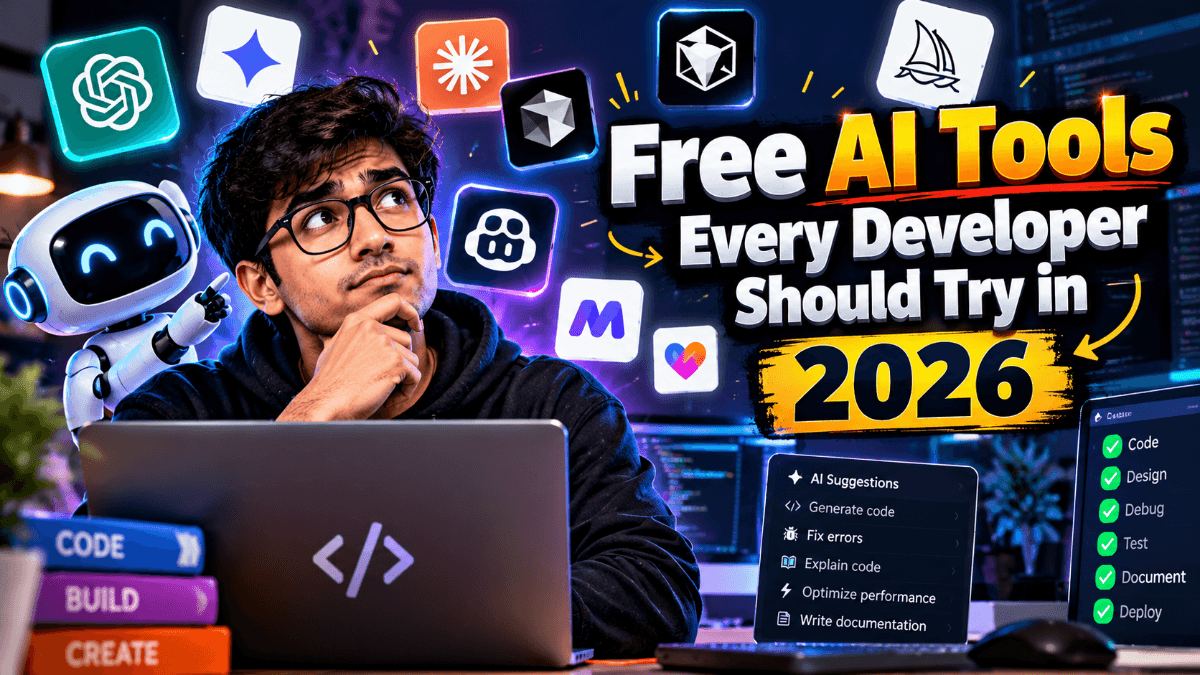
Search for "free AI tools" and you will find lists of a hundred or more. Look closely and most of them are free trials, heavily limited demos, or products that are free only until the beta ends. For developers, that distinction matters: you do not want to build a workflow or a prototype on something that starts charging next month.
The good news is that developers are better served by genuinely free options than almost any other audience. This article covers the categories where free tools are actually usable, and what to watch out for.
What "free" really means
Before looking at specific tools, it helps to separate four very different things that are all marketed as free:
A permanent free tier: limited, but usable indefinitely.
A free trial: typically seven or fourteen days, often requiring a card and converting automatically.
A freemium demo: technically free, but so limited it functions as an advert.
Free during beta: fine to experiment with, risky to depend on.
Permanent free tiers are rare in AI because every model request costs the provider computing power. Where they do exist, they tend to be in developer infrastructure rather than consumer apps.
1. Coding assistants
GitHub Copilot now offers a free plan with a monthly allowance of code completions and chat requests, which is enough for side projects and for evaluating whether an AI assistant suits the way you work. Open-source extensions such as Continue let you connect an editor to a model of your choice, including models running on your own machine.
2. Running models locally
Tools such as Ollama make it simple to download and run open-weight language models on your own hardware. Once a model is downloaded there is no per-request cost at all, which makes local models ideal for experimenting with prompts, building offline tools, or processing data you would rather not send to a third party. The trade-off is that you need a reasonably capable machine, and the smaller models that run comfortably on a laptop are less capable than the leading hosted ones.
3. Model hubs and APIs
Hugging Face hosts a huge library of open models, datasets and demo applications, and is free to browse, download from and experiment with. Several major model providers also offer free API access with rate limits, Google AI Studio for Gemini being a well-known example, which is enough to build and test a prototype before paying for production usage.
4. Infrastructure with real free tiers
This is where the strongest free options live. Netlify offers a permanent free tier for hosting websites and apps, with serverless functions that can proxy calls to a model API. Pinecone provides a free tier for its vector database, sized for prototypes and small retrieval projects. Activepieces, an open-source workflow automation platform, can be self-hosted at no cost, so the free path is structural rather than a marketing decision.
Where developers get caught out
Free tiers change. Limits are adjusted, features move to paid plans, and generous beta access ends. A few habits protect you:
Read the pricing page, not a third-party list, before building anything on a tool.
Keep your code portable, for example by wrapping model calls behind your own interface so you can switch providers.
Set spending caps on any account connected to a payment card.
Never expose API keys in front-end code, even on a free tier.
Checking what is actually free
Because pricing changes so often, it is worth checking a source that tracks it rather than relying on older roundups. The team at aisupermarket.ai checked the pricing of every tool in their directory and published the results in an honest look at which AI tools are genuinely free. The headline finding is striking: of 107 tools, only three had a permanent free tier, and all three were developer infrastructure.
Conclusion
For developers, "free AI" is less of a myth than it is for most users. Coding assistants, local models, model hubs and infrastructure platforms all offer genuinely usable free options. The key is knowing the difference between a free tier and a free trial, and building in a way that keeps you free to move when the terms change.