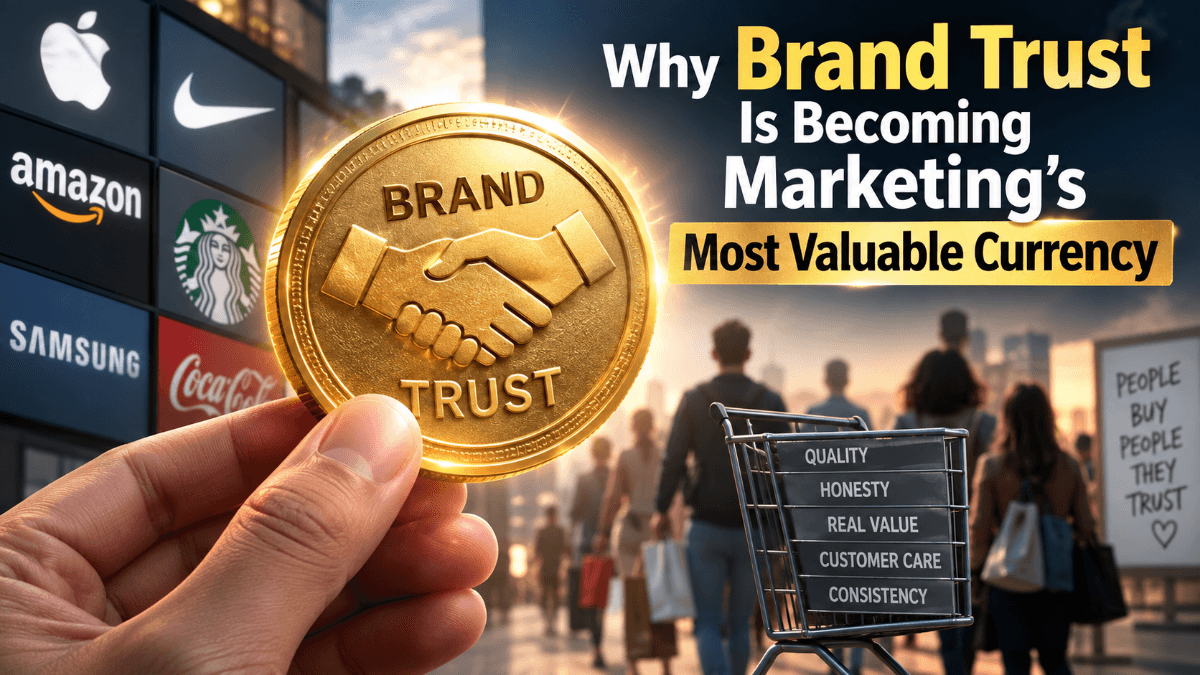
Marketing has spent the last two decades getting extremely good at capturing attention. Trust has become the harder, more valuable thing to earn, and increasingly the deciding factor in whether attention ever turns into a customer. In a landscape crowded with AI-generated content, aggressive automation, and brands making bigger promises with less accountability behind them, consumers have gotten noticeably more skeptical about who they actually believe, and that skepticism shows up directly in conversion rates.
What Changed
Consumers now have more ways than ever to verify a claim before acting on it, a quick search, a review site, a comment section, and they routinely use them. That shift punishes brands that treat marketing as pure persuasion and rewards brands that treat it as an extension of an actual, demonstrable promise. It also means that a single visible misstep, a mishandled rebrand, a tone-deaf campaign, an obviously exaggerated claim, spreads and sticks in a way that would have been far more contained a decade ago, when word of mouth traveled slower and less publicly.
What Building Real Trust Actually Requires
- Consistency over time, not just consistency within a single campaign. Trust compounds slowly and erodes quickly.
- Testing major changes with real customers before a public launch, rather than discovering the reaction in real time after the fact.
- Transparent handling of mistakes, since how a brand responds to a misstep often matters more to long-term trust than the misstep itself.
- Proof, not just claims, whether that's case studies, verifiable data, or simply a track record customers can check for themselves.
- Alignment between marketing promises and the actual customer experience, since a gap between the two is usually where trust breaks down fastest.
Why This Matters More for Growing Businesses Than Established Ones
Large, established brands can usually absorb a single trust misstep, they have decades of accumulated goodwill acting as a buffer. Smaller and growing businesses don't have that cushion. A single visible failure to deliver on a promise, or an obviously misleading claim, can do disproportionate damage precisely because there isn't yet a long track record to offset it. That makes the discipline of building trust deliberately, rather than treating it as a by product of good marketing, more urgent for growing businesses than it is for the household names that dominate most of the conversation around branding.
The businesses that treat brand trust as a strategic asset, worth protecting and slow to spend, tend to weather market shifts and platform changes far better than those chasing short-term attention at the expense of credibility. A recent, well-documented example of how quickly a trust misstep can turn expensive is worth reading in full in this look at what a poorly tested rebrand actually cost one major brand, including the real financial numbers behind recovering from it.