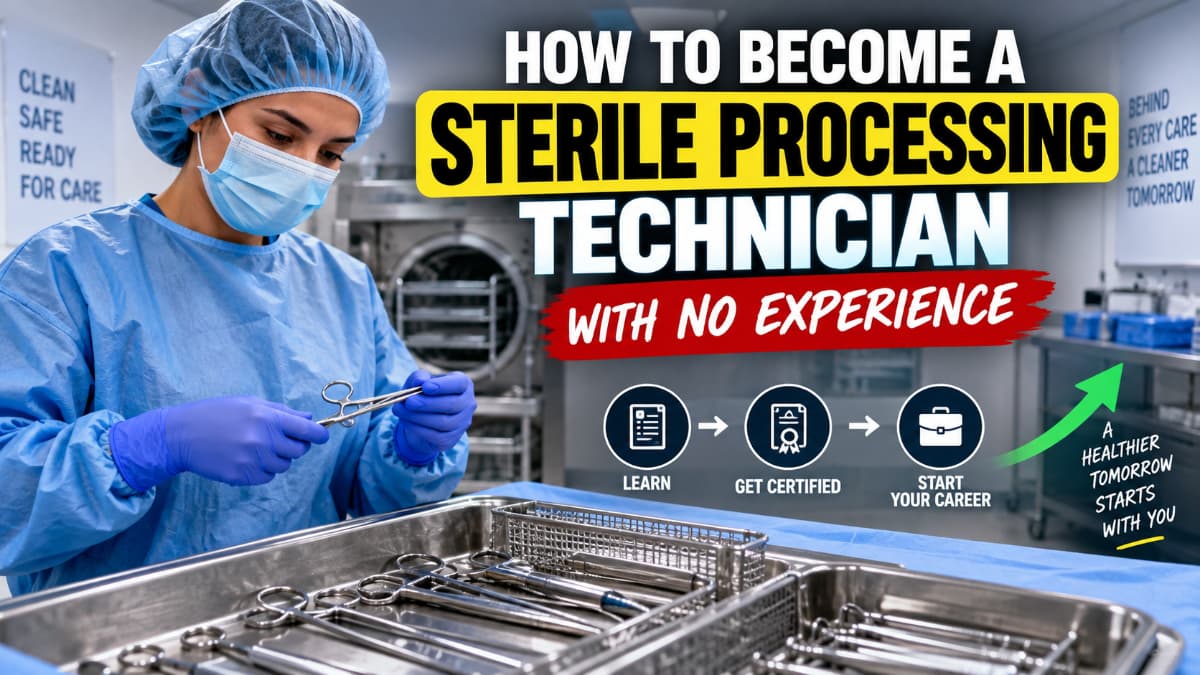
Getting your first healthcare job can feel like a closed loop: employers want experience, but you need a job to get that experience.
Sterile processing is one of the healthcare careers where beginners can break that cycle. You do not need previous hospital experience, a nursing degree, or four years of college to begin preparing for the profession.
What you do need is a clear path from training to certification and then to your first hands-on experience.
Can You Become a Sterile Processing Technician With No Experience?
Yes. People enter sterile processing from retail, hospitality, warehouses, manufacturing, delivery, office work, and many other industries.
Previous healthcare experience can be useful, but it is not necessary to start learning the profession.
Some skills from other jobs also transfer surprisingly well. Sterile processing requires attention to detail, following procedures, organization, documentation, quality control, teamwork, and the ability to work accurately under pressure.
The technical healthcare knowledge can be learned.
What Does a Sterile Processing Technician Do?
Sterile Processing Technicians work behind the scenes in hospitals and surgical facilities. They help ensure reusable surgical instruments are properly processed before they return to clinical use.
Typical responsibilities include:
decontaminating used instruments;
inspecting instruments for cleanliness and damage;
identifying and assembling surgical instruments;
preparing and packaging sets;
operating sterilization equipment;
monitoring sterilization processes;
storing and distributing sterile supplies.
There is usually little or no direct patient contact, which makes the profession especially interesting for people who want to work in healthcare without choosing a patient-facing career.
If you are still deciding whether the profession fits you, this breakdown of whether sterile processing is a good career explains the advantages, challenges, and realistic expectations in more detail.
Do You Need a Degree?
A four-year degree is not the standard entry route into sterile processing.
But “no degree required” should not be confused with “no training required.”
Technicians need to understand infection prevention, decontamination, surgical instrumentation, preparation and packaging, sterilization methods, quality assurance, and department workflow.
For someone with no healthcare background, structured training can make the transition much easier than trying to learn everything from unrelated videos and study materials.
What About CRCST Certification?
CRCST — Certified Registered Central Service Technician — is one of the best-known entry-level credentials in sterile processing.
Beginners sometimes assume they cannot pursue certification because they do not already have hundreds of hours of hospital experience.
However, CRCST has a provisional route that allows candidates to take the exam first and complete the required hands-on experience afterward within the applicable timeframe.
That creates a realistic pathway for someone starting from zero:
training → CRCST preparation → exam → provisional certification → hands-on experience → full certification
The required practical experience still has to be completed. The important point is that you do not necessarily need to have all of it before sitting for the exam.
How Do You Get Your First Sterile Processing Job?
Do not automatically reject yourself because a job posting says experience is “preferred.”
Preferred and required are not the same thing.
Employers can evaluate several factors, including training, certification status, availability, previous work experience, and the needs of the department.
It also helps to search different job titles. Positions may appear as:
Sterile Processing Technician;
Sterile Processing Tech;
SPD Technician;
Central Service Technician;
Central Sterile Technician.
The first position is usually the hardest because you are still building your professional history. Once you begin accumulating real sterile processing experience, future applications become much stronger.
Training Matters More When You Are Starting From Zero
Someone already working in healthcare may understand hospital terminology and workflows before beginning sterile processing training.
A career changer usually does not.
That is why beginners benefit from learning the profession in a logical sequence rather than trying to guess what matters most for the exam and the job.
Multyprep offers a Sterile Processing Technician training program designed for students entering the profession from different backgrounds.
The program runs for 14 weeks with live online instruction and includes study materials, CRCST preparation, and more than 1,000 practice questions.
The goal is not simply to complete a course. It is to understand sterile processing well enough to move confidently toward certification and employment.
What If You Already Have a Full-Time Job?
Many people considering sterile processing cannot simply stop working while they study.
That is normal for adult career changers.
Online live classes can reduce the time and cost of commuting, while a structured schedule makes it easier to plan study around work and family responsibilities.
The career transition can therefore happen gradually: keep your current income, complete professional training, prepare for certification, and then begin applying for sterile processing positions.
What Should You Put on a Resume Without Healthcare Experience?
Do not invent medical experience you do not have.
Instead, show the legitimate skills from your previous jobs that are relevant to sterile processing.
That might include:
following detailed procedures;
inventory control;
quality checks;
documentation;
safety compliance;
organization;
working under deadlines;
identifying and reporting problems.
Training and certification status should also be presented clearly.
An employer does not need to believe you are already an experienced technician. The objective is to show that you are a serious entry-level candidate who has prepared for the profession.
Your First Job Is Only the Starting Point
Sterile processing can develop into much more than one entry-level position.
With experience, technicians can move toward roles such as:
Sterile Processing Technician → Lead Technician → Supervisor → Manager → Director
That is why having no experience today does not have to be a major obstacle.
You do not need to wait until someone magically gives you healthcare experience. You can start by learning the profession, preparing for certification, and building the qualifications that make the first employer more likely to say yes.