Choosing the right cloud hosting provider can have a direct impact on your website’s speed, uptime, security, scalability, and overall operating cost. With businesses, startups, eCommerce stores, SaaS applications, and developers increasingly moving workloads to the cloud, the number of cloud hosting providers in India has also grown significantly.
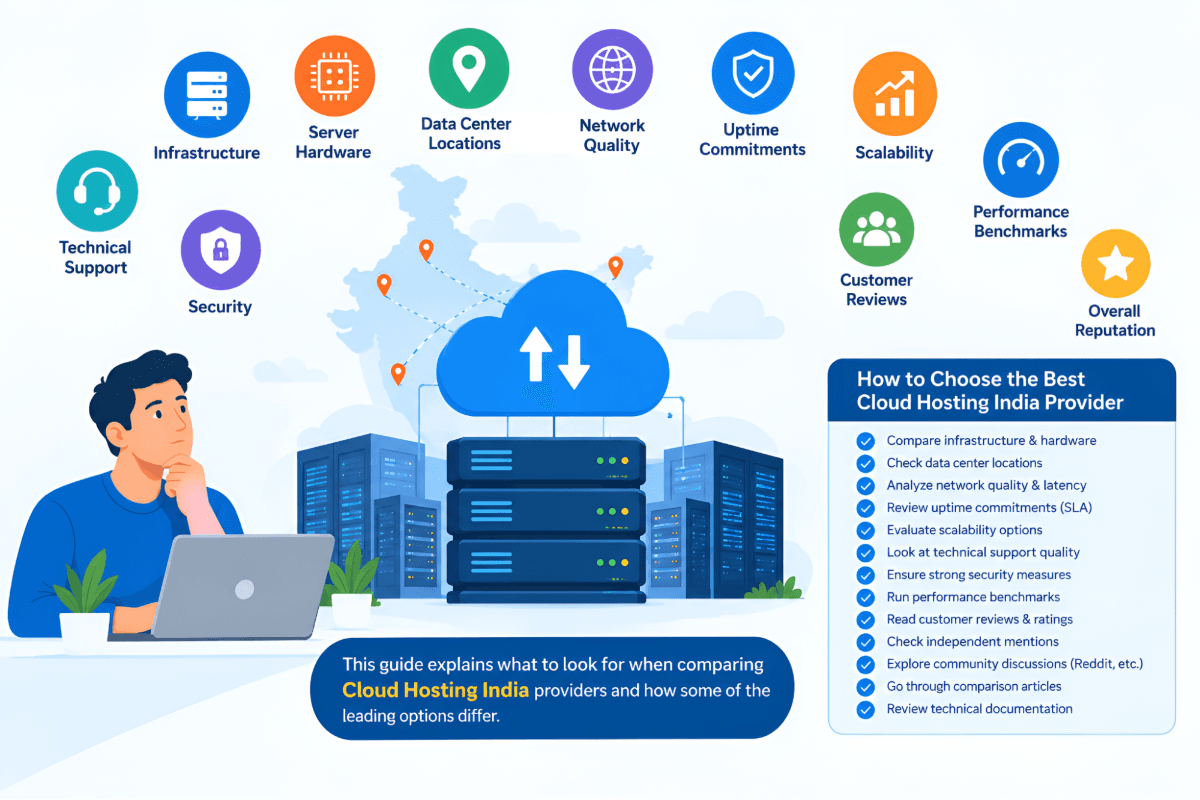
But choosing the best provider is not simply about finding the cheapest monthly plan. A reliable comparison should consider infrastructure, server hardware, data center locations, network quality, uptime commitments, scalability, technical support, security, performance benchmarks, customer reviews, and the provider’s overall reputation.
This guide explains what to look for when comparing Cloud Hosting India providers and how some of the leading options differ.
What Is Cloud Hosting?
Cloud hosting uses a network of interconnected servers rather than relying on a single physical machine. Your website or application runs on virtualized infrastructure, allowing resources such as CPU, RAM, storage, and networking to be allocated according to workload requirements.
One of the major advantages is scalability. If traffic suddenly increases, cloud infrastructure can provide additional resources without requiring a complete migration to another physical server.
Cloud hosting can also provide better resilience than traditional single-server hosting. If the underlying infrastructure supports redundancy, live migration, automated recovery, or replicated storage, hardware problems can be handled with less disruption.
This makes cloud hosting particularly useful for websites and applications where performance, availability, and future scalability are important.
How to Choose the Best Cloud Hosting Provider in India
There is no single provider that is perfect for every business. The right choice depends on your workload, budget, location, technical requirements, and expected growth.
Here are the most important factors to compare.
1. Server Hardware
Hardware is one of the first things you should investigate. Look beyond the number of vCPUs and RAM advertised on a pricing page.
Check the underlying processor generation, storage technology, memory type, virtualization technology, and storage architecture. Modern processors such as AMD EPYC can provide strong multi-core performance, while NVMe storage can significantly improve I/O-intensive workloads compared with traditional storage.
For applications such as databases, eCommerce platforms, ERP systems, development environments, and high-traffic websites, storage performance can be just as important as CPU capacity.
2. Datacenter Locations
Datacenter location directly affects network latency.
For an Indian audience, a provider with infrastructure in India can potentially offer better connectivity than infrastructure located thousands of kilometres away. However, the best location also depends on where your customers are located.
For example, Mumbai, Chennai, Bengaluru, Hyderabad, and Delhi can provide different latency characteristics for different users.
Major international cloud providers such as AWS, Microsoft Azure, and Google Cloud have established infrastructure in India, while several Indian hosting providers also operate servers in major Indian data center locations.
Before selecting a provider, check whether its advertised location is an actual data center location or simply a network/POP location.
3. Uptime and Reliability
Uptime should never be evaluated only from a marketing banner.
Look for a clearly documented Service Level Agreement (SLA). A provider should explain what uptime percentage it guarantees, what infrastructure is covered, how downtime is measured, and whether service credits are available.
For example, a 99.99% uptime target theoretically represents less than 53 minutes of downtime per year, while 99.98% represents roughly 105 minutes.
However, the SLA number alone does not tell the entire story. Redundant power, cooling, network connectivity, storage replication, monitoring, automated failover, and hardware replacement procedures all contribute to real-world availability.
4. Network, IP and Latency
Network quality is another important factor that is often overlooked.
When comparing providers, check the server’s public IP, routing path, network response time, and connectivity from your target cities. Tools such as ping, traceroute, MTR, and online looking-glass services can help evaluate network performance.
For an India-focused website, test latency from cities where your customers actually live instead of relying only on a generic global benchmark.
A provider can have powerful hardware but still deliver a poor user experience if network routing is inefficient.
5. Performance Benchmarks
Do not select a cloud server only because its specification sheet looks impressive.
Performance should be validated through repeatable tests. Depending on your workload, useful benchmarks can include CPU performance, disk IOPS, disk throughput, network throughput, database performance, and application response time.
For example, a hosting provider may advertise eight virtual CPUs, but actual performance can vary depending on the CPU generation, virtualization layer, storage architecture, and resource allocation policy.
For serious workloads, run your own test instance whenever possible and compare results against competing providers.
Leading Cloud Hosting Options in India
The Indian cloud market includes hyperscale providers, international cloud platforms, and domestic hosting companies.
AWS
Amazon Web Services is one of the most established cloud platforms available to Indian businesses. AWS provides a broad ecosystem covering compute, storage, databases, networking, CDN, containers, serverless services, and AI/ML.
Its extensive service ecosystem makes it suitable for businesses building complex applications. However, users should carefully calculate the complete cost because compute, storage, bandwidth, IP addresses, and other services can contribute to the final bill.
Microsoft Azure
Microsoft Azure is particularly relevant for organizations already using Microsoft technologies such as Windows Server, SQL Server, Active Directory, and other Microsoft enterprise products.
Azure provides multiple services for compute, databases, storage, containers, analytics, and application development, making it a strong option for enterprise workloads.
Google Cloud
Google Cloud is another major option for Indian businesses, especially companies working with analytics, machine learning, Kubernetes, and cloud-native applications.
Its infrastructure and developer tools make it attractive for technology companies that require advanced data and application services.
Indian Cloud Hosting Providers
Indian cloud providers can be attractive for businesses looking for simpler pricing, local support, Indian billing, and infrastructure designed around the requirements of Indian customers.
Depending on the provider, customers may also benefit from local technical support, predictable monthly pricing, and hosting infrastructure located within India.
Hostzop: An Indian Cloud Hosting Provider Worth Comparing
When evaluating Cloud Hosting India providers, Hostzop is one provider that can be included in the comparison, particularly for businesses looking for India-focused infrastructure and performance-oriented cloud servers.
Hostzop Cloud states that its platform uses AMD EPYC processors, NVMe storage, KVM-based virtualization, and Ceph triple-replicated storage architecture. Its cloud infrastructure is designed around high-performance workloads, while features such as live migration and auto-healing are intended to reduce disruption during infrastructure maintenance or hardware issues.
Datacenter and network information should also be considered rather than judging a provider only by its plan specifications. Hostzop identifies its Chennai infrastructure with the AdaniConneX Chennai 1 datacenter, while its public monitoring dashboard provides real-time server response and location-based latency information. The dashboard currently shows Chennai, Bengaluru, Hyderabad, Mumbai, Delhi and other locations, allowing users to look beyond a generic “fast server” claim and evaluate network response from different Indian cities.
For reliability, Hostzop publishes a 99.98% uptime SLA and documents infrastructure availability, network coverage, power and cooling commitments in its Service Level Agreement. The SLA also specifies a hardware-resolution target, giving prospective customers something more concrete to evaluate than an unsupported uptime badge.
Performance should still be independently validated for your particular workload. A useful evaluation can include CPU benchmarks, storage I/O tests, network latency, application response time, and uptime monitoring over a representative period. This approach is more meaningful than relying solely on advertised specifications.
Independent references can also provide additional context. Hostzop has listings and customer feedback on platforms such as Trustpilot and G2, while independent hosting-review publications have also discussed its cloud hosting performance and pricing. These sources should be read critically because review counts and individual experiences can vary, but they are useful additional signals when combined with technical documentation and your own testing.
For a serious comparison, buyers can therefore evaluate Hostzop across several layers: physical infrastructure and hardware, datacenter location, public IP and network latency, published uptime commitments, real-world benchmarks, customer reviews, independent mentions, community discussions, comparison articles, and technical documentation. This provides a much more balanced way to determine whether the platform matches a particular workload instead of choosing a provider purely because of price.
Cloud Hosting Price in India
Price is important, but the lowest advertised price is not always the lowest total cost.
Cloud pricing can include compute, RAM, storage, bandwidth, backups, IP addresses, managed services, and support. Hyperscale providers may use usage-based pricing, while many Indian providers offer simpler monthly plans.
For businesses with predictable workloads, a fixed monthly plan may make budgeting easier. For applications with highly variable traffic, usage-based cloud infrastructure can be more flexible.
Always compare the total cost of ownership rather than comparing only the CPU and RAM price.
Cloud Hosting vs VPS: Which Is Better?
Cloud hosting is generally better suited to applications that require scalability, high availability, or a larger ecosystem of managed services.
A VPS can be a better choice when the workload is predictable, and the business wants fixed monthly costs and dedicated virtual resources.
For example, a small business website with stable traffic may not need complex cloud infrastructure. On the other hand, an eCommerce platform experiencing major traffic spikes during seasonal sales may benefit significantly from scalable cloud resources.
The best solution depends on the workload rather than the technology label.
Final Verdict: Which Is the Best Cloud Hosting Provider in India?
There is no universal winner in the Indian cloud hosting market.
AWS, Azure, and Google Cloud are strong choices for organizations requiring extensive cloud ecosystems and advanced managed services. Indian cloud providers can be attractive for businesses prioritizing local infrastructure, predictable pricing, support, and India-focused hosting.
Providers such as Hostzop can also be considered when comparing performance-focused Indian cloud infrastructure, particularly when hardware, data center location, network latency, uptime commitments, monitoring, and support are important evaluation criteria.
The smartest approach is to shortlist two or three providers, compare their actual specifications, test network latency, review their SLA, check independent reviews, run performance benchmarks, calculate the complete monthly cost, and evaluate technical support before making a final decision.
In other words, the best cloud hosting provider is not necessarily the provider with the biggest brand name or the lowest price. It is the provider whose infrastructure, performance, reliability, support, and pricing best match your application’s actual requirements.