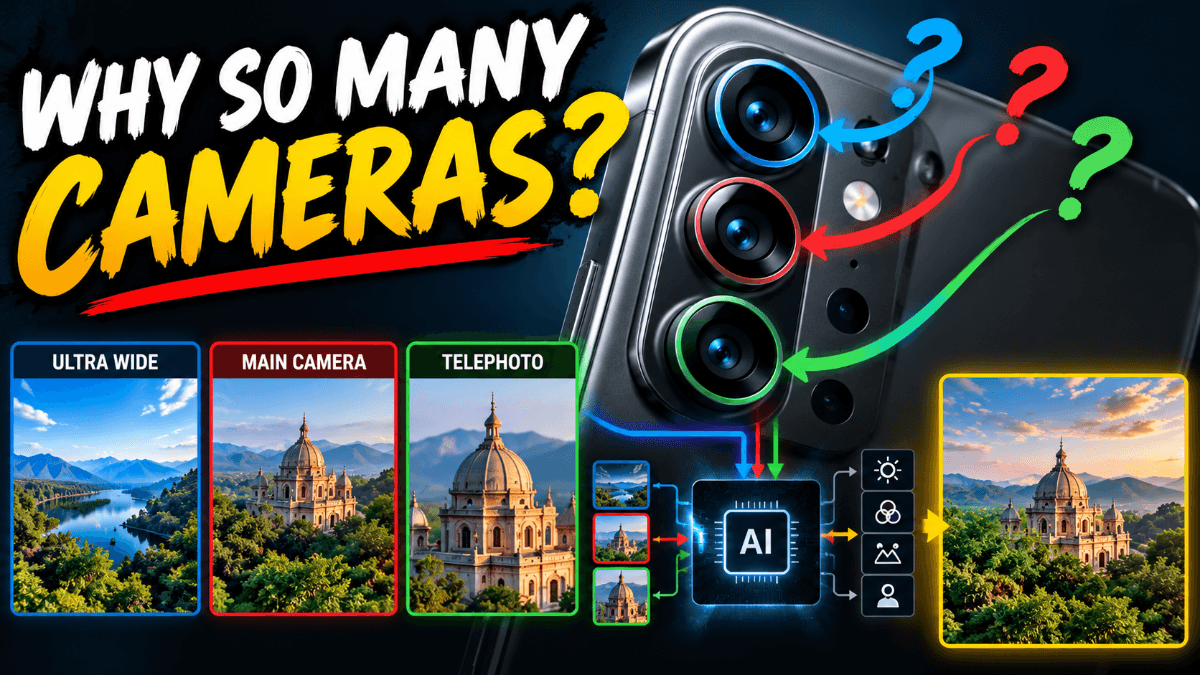
Check your phone right now. Flip it over. You'll probably see two, three, sometimes four camera lenses staring back at you.
Most of us have a vague theory about why: "better photos," maybe, or "marketing gimmick" if we're cynical. But here's the thing — older phones managed with a single camera and still took perfectly good pictures. So why did phone cameras suddenly start multiplying?
The answer isn't marketing. It's physics — and it traces back further than you'd expect, all the way to space telescopes.
The Problem With a Single Camera
For years, a single rear camera was the standard, and it worked fine — for one specific kind of photo: whatever was directly in front of you, at a normal distance, in decent light.
The trouble started the moment people wanted more than that. Zoom into something far away, and the photo turned grainy and blurry — the kind of image quality you'd associate with security camera footage, not a memory you want to keep. Try to blur the background behind a portrait, the way a DSLR does, and a single small phone lens simply couldn't do it. Try to fit an entire group photo or a wide landscape into frame, and you'd end up cropping people out or stepping back into traffic.
One lens, it turned out, could not physically do all of these jobs at once. And that limitation is exactly what triggered the multi-camera era.
Solving Zoom Without Making the Phone Thicker
The first challenge engineers tackled was zoom.
Traditional cameras achieve real optical zoom by using a longer lens — the kind of lens that physically extends outward, like on a DSLR. But nobody wants a phone that bulges out of their pocket like a mini camera bag.
The solution was periscope optics — a design borrowed, quite literally, from submarine periscopes. Instead of a straight lens, engineers bent the light path sideways inside the phone using mirrors or prisms. This let manufacturers fit a much longer effective focal length into a slim phone body, giving you real optical zoom (not the digital, cropped-in kind) without adding bulk.
In short: there's a tiny periscope living inside your phone, and it only comes into play the moment you pinch to zoom.
Why You Need Two Cameras for a Blurred Background
The second problem was depth — specifically, that soft, blurred-background look known as bokeh, which makes portrait photos look professionally shot.
A single lens can't calculate depth on its own, for a simple reason: depth perception requires two points of reference. This is the same principle behind human vision. Close one eye, and you lose a lot of your sense of how far away things are — because your brain calculates depth by comparing the slightly different images your two eyes see and measuring the difference.
Phone manufacturers copied this exact trick. A second camera, positioned slightly apart from the primary one, captures the same scene from a marginally different angle. Software then compares the two images and calculates a depth map — figuring out what's close, what's far, and how much to blur the background accordingly.
That's why phones with just one rear camera generally can't produce a true optical bokeh effect. They're missing the second "eye" needed to judge distance.
The Third Lens: Solving the "Everyone Won't Fit" Problem
The third common addition is the ultrawide lens, and its job is more straightforward — it exists to capture more of the scene. Group photos, tall buildings, cramped indoor spaces, sweeping landscapes: situations where stepping back further simply isn't an option.
So by this point, most modern phones are running three distinct lenses, each solving a completely different physical limitation:
- Primary lens → everyday, balanced photography
- Periscope/telephoto lens → real optical zoom without added thickness
- Ultrawide lens → fitting more into the frame
- (Often paired with) a depth sensor → for accurate bokeh
Do All the Cameras Work at the Same Time?
This is where a lot of people get confused. If a phone has three or four cameras, are they all firing simultaneously every time you tap the shutter?
Not usually. Your phone's camera software decides, in real time, which lens (or combination of lenses) is best suited to the shot you're taking — based on distance, lighting, zoom level, and subject. In many cases, especially in flagship phones, multiple lenses capture data simultaneously and the software blends the results into a single, optimized final image. This is part of what's often called "computational photography" — the phone isn't just capturing light, it's actively processing and combining multiple data sources to build a better picture than any single lens could produce alone.
The Surprising Origin: NASA Got There First
Here's the part that changes how you look at your phone entirely.
The idea of using multiple lenses to capture more information than a single lens ever could didn't start with smartphones — it started with space telescopes. NASA has long used multi-lens and multi-instrument imaging systems to capture wider, more detailed views of the universe in a single observation, combining data the same way your phone now combines data from its multiple lenses.
Decades later, that same fundamental principle — multiple viewpoints, combined computationally into one superior image — ended up miniaturized, mass-produced, and sitting in your pocket.
The Takeaway
Multiple cameras on a phone were never about looking impressive in a spec sheet. Each lens exists to solve one physical problem that a single piece of glass simply cannot solve on its own: zoom without bulk, depth without a second eye, and width without stepping back.
And the underlying idea — multiple lenses working together to see more than one lens ever could — is the same idea that once helped scientists photograph the universe.
Next time you glance at your phone's camera bump, it's worth remembering: that's not just a phone camera. That's decades of optical engineering, borrowed from submarines and space telescopes, shrunk down to fit in your hand.
Frequently Asked Questions4 FAQs
Quick answers to common questions about this topic
Because a single lens can't handle zoom, depth-of-field blur, and wide-angle shots equally well - each requires different optics, so manufacturers use separate lenses for each job.
It's a zoom lens design where light is bent sideways using mirrors or prisms, allowing a long focal length (and real optical zoom) to fit inside a slim phone body.
Two cameras capture the same scene from slightly different angles, similar to human eyes, letting software calculate depth and blur the background accurately.
Not always — the phone's software chooses the most suitable lens (or combination) based on the shot, and in many cases blends data from multiple lenses into one final image.