Affiliate marketing is often presented as one of the simplest ways to make money online. The basic idea seems straightforward: recommend a product or service, send a customer to the advertiser, and receive a commission when a certain action takes place. But behind this simple concept is an increasingly sophisticated digital ecosystem built around technology, data, advertising, content, and customer acquisition.
Modern affiliate marketing has little in common with the early days of referral links and banner advertising. Today, an affiliate campaign can involve search engine optimization, paid media, analytics platforms, tracking systems, APIs, landing pages, automation, artificial intelligence, and several different companies working together.
This shift is particularly interesting from a technology perspective. The visible part of affiliate marketing may be a review, comparison article, social media post, or advertisement, but a significant amount of infrastructure operates behind it. That infrastructure determines where a visitor came from, what they did on a website, whether they converted, and how much revenue the campaign generated.
As Artem Lashyn, CBDO at Digital Hustlers, explains from his experience working across affiliate media, partnerships, and digital growth, affiliate marketing is increasingly becoming a broader performance-based ecosystem rather than simply a model built around referral links. This shift is particularly visible in industries such as iGaming, where affiliate partnerships have become an important part of customer acquisition, brand growth, and performance marketing strategies. The technology supporting that ecosystem is becoming just as important as the content and traffic that users see.
Understanding how these systems work provides a useful perspective not only for affiliates and advertisers, but also for marketers, developers, SEO specialists, and technology companies looking for new ways to reach customers.
From Referral Links to a Technology-Driven Industry
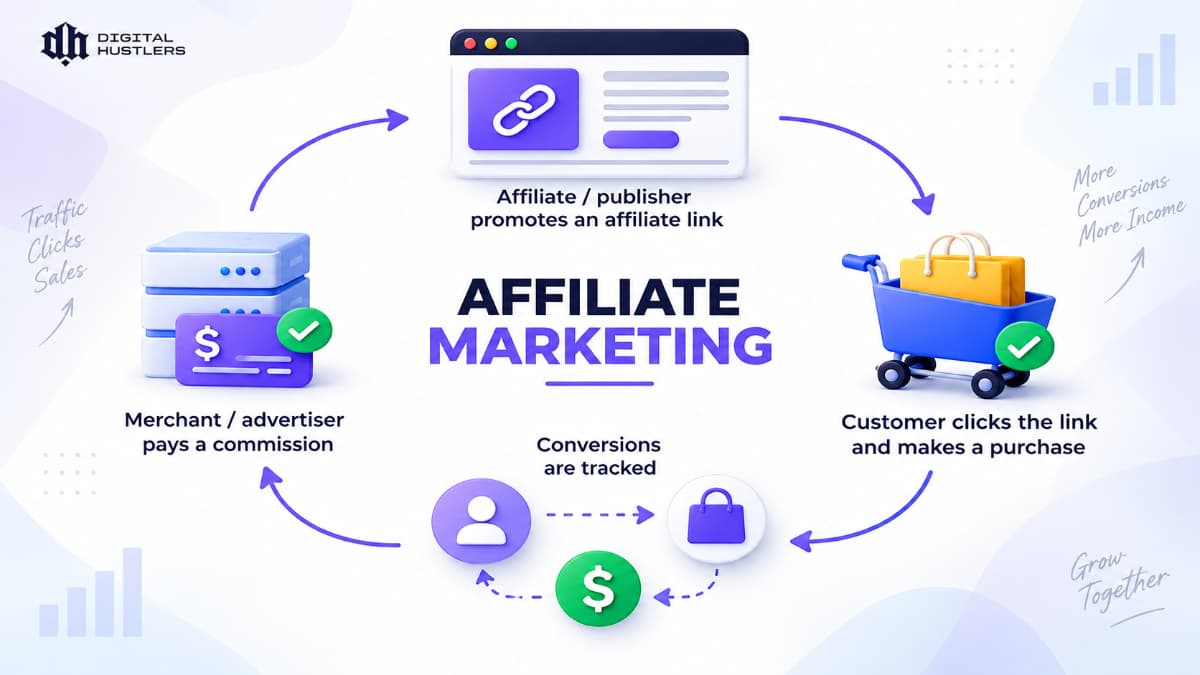
The basic relationship in affiliate marketing has remained relatively stable. A company has a product or service it wants to sell, an affiliate has access to an audience, and both sides benefit when that audience generates a valuable action.
What has changed is the infrastructure connecting them.
A modern affiliate campaign may begin with a user searching for information on Google. The user finds an article, clicks through to another website, interacts with a landing page, and eventually completes a purchase or registration. Several systems may record different parts of that journey. Tracking software identifies the source of the visitor, analytics tools measure their behavior, and the advertiser's own systems confirm whether the desired action took place.
The affiliate then receives a commission according to the terms of the campaign.
From the user's perspective, the process may take only a few minutes and look completely ordinary. From the business perspective, however, it involves a chain of technical events that needs to work correctly.
This is one of the reasons affiliate marketing has developed into a professional industry rather than remaining a simple form of online referral.
How Affiliate Tracking Connects Traffic With Revenue
Tracking is one of the most important technologies in affiliate marketing because the entire business model depends on knowing where a conversion came from.
Imagine that a technology publisher recommends a cloud software product in an article. A reader clicks the publisher's link and visits the software company's website. The reader does not purchase immediately, but returns several days later and becomes a paying customer.
The advertiser needs to be able to determine whether that customer should be attributed to the affiliate.
This can involve tracking parameters, cookies, pixels, server-to-server communication, postback systems, or other technical methods. The exact implementation depends on the advertiser, affiliate network, platform, and industry.
The purpose, however, is always similar: connect an action performed by a customer with the source that generated that customer.
Reliable attribution matters because money is involved on both sides. If conversions are not tracked correctly, affiliates may not receive the commissions they have earned, while advertisers may make incorrect decisions about which traffic sources are actually producing customers.
As affiliate operations become larger, the importance of accurate data only increases.
Why Traffic Alone Does Not Make an Affiliate Campaign Successful
One of the easiest mistakes to make when looking at affiliate marketing is to focus too much on traffic.
A website can receive thousands of visitors and still generate very little revenue. Another website with a much smaller audience may earn considerably more because its visitors are closer to making a purchase.
The same principle applies to paid advertising.
An affiliate can spend $1,000 on advertising and generate 10,000 clicks, but those clicks have little value if only a handful of users convert. Another campaign may generate fewer clicks but produce significantly more revenue.
This is why affiliate marketing is fundamentally connected to performance marketing. The goal is not simply to generate attention. It is to understand what happens after the user arrives and whether the resulting business value justifies the cost of acquiring that user.
A simplified customer journey might look like this:
Traffic → Click → Landing Page → User Action → Conversion → Revenue
Every stage can influence the final result. The quality of the traffic matters, but so do the landing page, the offer, the user experience, the conversion process, and the economics of the transaction.
Technology allows affiliates and advertisers to measure these stages instead of relying entirely on assumptions.
The Growing Role of SEO and Content
Search engine optimization remains one of the most important traffic sources for affiliate businesses, especially those built around content.
The concept is simple. An affiliate creates useful information around a topic that people are already searching for. That content attracts visitors from search engines, and some of those visitors may eventually purchase a recommended product or service.
Technology websites are particularly suitable for this model because people frequently research software and digital products before buying them.
A person looking for project management software may search for comparisons between different platforms. Someone building a website may research hosting providers. A small company may compare CRM systems before choosing one. A developer might search for a particular API, database, or development tool.
In all of these cases, the user is looking for information before making a decision.
This creates an opportunity for publishers to combine useful editorial content with affiliate partnerships. A good article does not need to feel like an advertisement. Its primary purpose can be to explain the differences between products, identify important features, discuss limitations, and help readers decide what is suitable for their particular situation.
The commercial relationship comes after the value provided to the reader.
That distinction is becoming increasingly important as search engines and users become better at recognizing low-value content.
Why First-Hand Knowledge Matters
Affiliate content has become much more competitive. Publishing an article around a keyword is no longer enough to guarantee that people will trust it or that it will perform well in search.
Readers have access to an enormous amount of information, including AI-generated content, automated product descriptions, reviews, comparison websites, forums, videos, and social media discussions.
In this environment, first-hand knowledge can become a significant advantage.
Someone who has actually worked with a product, run advertising campaigns, built websites, managed partnerships, or analyzed performance data can often provide details that are difficult to reproduce through generic research.
This is also where the people behind affiliate businesses and media companies become relevant. Their professional experience can provide context that goes beyond the information available on a product page.
For an affiliate website, that may mean explaining how a tool performs in a real workflow rather than simply repeating its advertised features. For an industry publication, it may mean speaking with people who actually work in the market and using their experience to explain broader trends.
The technology may enable the process, but human expertise remains an important part of making the information useful.
Data Has Become a Core Part of Affiliate Marketing
The more campaigns an affiliate runs, the more data is generated.
There can be information about traffic sources, advertising campaigns, landing pages, countries, devices, conversions, revenue, customer behavior, and many other variables. At a certain scale, managing this information manually becomes difficult.
This is where analytics and automation become essential.
Consider two campaigns that each generate 100 conversions. At first, they appear equally successful. But suppose the first campaign costs $5,000 while the second costs $2,500. The number of conversions is identical, but the economics are completely different.
An affiliate therefore needs more than a conversion count. They need to understand how much was spent to generate those conversions and how much revenue those customers ultimately produced.
The same logic applies to content.
An article receiving 50,000 visitors may appear more successful than one receiving 5,000 visitors. But if the smaller article generates significantly more revenue because its audience has stronger purchase intent, the traffic numbers tell only part of the story.
Data allows affiliate businesses to move from assumptions to measurable decisions.
APIs and Automation Behind the Scenes
As affiliate businesses grow, automation can eliminate many repetitive tasks.
APIs are particularly useful because they allow different systems to communicate with each other. Advertising platforms, tracking systems, analytics tools, affiliate networks, and internal dashboards can exchange information without requiring employees to manually copy data from one system into another.
For a small publisher, this may not be a priority. A website with a handful of articles and one affiliate program can often be managed with relatively simple tools.
At a larger scale, however, the situation changes. An affiliate business operating across several countries, traffic sources, and offers may need to process a large amount of information every day.
Automation can help with reporting, campaign monitoring, notifications, data processing, and other repetitive processes. Instead of spending time collecting information, teams can focus more of their attention on understanding the results and deciding what to do next.
This is one of the less visible ways in which technology has changed affiliate marketing. The user may see a single link on a webpage, while an entire set of automated systems is working behind it.
How Artificial Intelligence Is Changing Affiliate Work
Artificial intelligence is adding another layer to this transformation.
AI tools can already assist with research, content planning, data analysis, translation, image creation, customer support, advertising concepts, and many other tasks. For affiliate teams, this can reduce the amount of time spent on repetitive work.
For example, an AI system can help organize large amounts of research or identify patterns in campaign data. It can also assist with creating initial content outlines or generating ideas for advertising creatives.
But automation does not remove the need for human judgment.
Creating thousands of pages with AI does not automatically create a successful affiliate business. The pages still need to answer real questions, provide useful information, and attract the right audience. Similarly, generating hundreds of advertising variations does not solve the problem of finding a profitable campaign if the underlying offer or audience is wrong.
AI is therefore more useful when it improves an existing process rather than simply increasing the amount of content or advertising produced.
The distinction is important. More output is not necessarily more value.
Affiliate Marketing Across Different Industries
Although affiliate marketing is often associated with e-commerce, the model is used across a much wider range of industries.
Software companies use affiliates to generate subscriptions. Financial businesses can work with publishers that attract potential customers. Travel websites can partner with content creators and comparison platforms. Education companies can reward partners for bringing new students.
Mobile applications, subscription services, digital products, and many other businesses can also use affiliate partnerships.
Each vertical has its own economics and customer journey.
A software affiliate may receive recurring revenue from a customer who continues paying for a subscription. An e-commerce publisher may receive a percentage of a single purchase. A lead-generation campaign may pay when a user submits a qualified application.
This variety is another reason technology matters. Different business models require different tracking systems, attribution methods, reporting structures, and integrations.
There is no single technical architecture that works for every affiliate business.
Why Trust Is Becoming More Valuable
Technology has made it easier than ever to publish content, distribute advertising, and reach an audience. It has also made it easier to produce large amounts of low-value material.
That creates a new challenge: trust.
When a user searches for information about a product, they may encounter dozens of websites making similar recommendations. If those pages provide little original information, it becomes difficult for the reader to understand which source deserves attention.
Useful affiliate content needs to offer something beyond the existence of an affiliate link.
That could be first-hand experience, detailed comparisons, original research, expert commentary, practical testing, or simply a clear explanation of a complicated topic.
This is particularly relevant in technology, where products can have significant differences that are not obvious from a marketing page. A useful review might explain how a tool performs in a particular workflow, what its limitations are, how easy it is to integrate, or which type of user would benefit from it most.
In other words, technology can help scale affiliate marketing, but credibility helps make that scale valuable.
Where Affiliate Marketing Is Heading
The next stage of affiliate marketing will likely be shaped by the same forces affecting the wider digital economy: artificial intelligence, changing search behavior, privacy requirements, automation, new advertising formats, and increasingly sophisticated users.
Affiliate websites may become more interactive and resemble digital products rather than traditional blogs. Instead of publishing only articles, a publisher could combine editorial content with comparison tools, calculators, databases, personalized recommendations, newsletters, communities, and other features.
This could make affiliate websites more useful while creating new opportunities for monetization.
Search is also likely to become more diverse. Users already discover products through search engines, social platforms, video, communities, newsletters, and other channels. Affiliates that can build audiences across several channels may have more flexibility than businesses dependent on a single source of traffic.
At the same time, the underlying business model remains remarkably simple.
Companies want customers. Publishers and creators have access to audiences. Technology connects the two and makes it possible to measure the results.
The tools will change, but that relationship can continue to support the industry.
Final Thoughts
Affiliate marketing has moved far beyond the idea of putting a referral link on a website and waiting for a commission.
Today, it sits at the intersection of digital advertising, SEO, content, analytics, software, automation, and data. A modern affiliate campaign can involve sophisticated tracking systems, APIs, automated reporting, paid media, search optimization, and increasingly, artificial intelligence.
For technology professionals, affiliate marketing offers an interesting example of how software and data can transform a relatively simple business concept into a complex digital ecosystem.
For advertisers, it provides a performance-based way to work with external partners and acquire customers. For publishers and creators, it creates a way to monetize an audience by connecting people with products and services that are genuinely relevant to them.
And for the industry as a whole, the biggest shift may be that the referral link is no longer the center of the story.
The real value lies in everything that happens around it: understanding the audience, generating the right traffic, measuring user behavior, improving the customer journey, and using technology to turn those interactions into measurable business results.