Every web designer has a version of the same story. A small business owner gets in touch — a plumber, a dentist, someone opening a second coffee shop — and they need a website. The budget is a fraction of what the work costs. The brief is three sentences long. And somewhere in the first week, the project stalls on the same thing it always stalls on: nobody can picture the site yet, so nobody can make a decision about it.
That blank-page problem has quietly changed over the last two years, and it is worth looking at honestly rather than through the marketing lens. AI-generated first drafts are now good enough to put something concrete in front of a client on day one. They are not good enough to replace the designer. The interesting question is what that actually does to a workflow.
The real bottleneck was never the HTML
If you have built small business sites for any length of time, you know the production time is not the expensive part. A competent developer can turn a signed-off design into a working site quickly. What eats the budget is everything before that:
- Extracting a brief from a client who has never commissioned design before
- Writing placeholder copy because the client's copy never arrives
- Three rounds of revisions on a layout the client cannot visualise
- Explaining, repeatedly, why the logo cannot be bigger
None of that is technical work. It is a communication problem, and communication problems get cheaper the moment you have an artefact to point at. This is the part generated drafts genuinely help with, and it is a narrower claim than most of the marketing makes.
What a generated draft is actually good at
Having tested a number of these tools on real briefs, a consistent pattern emerges. Generated output is strong where the answer is conventional and weak where it needs judgement.
Strong: structure. A service business site has a known shape. Hero with a clear value proposition, services, proof, pricing or a quote request, contact.
A generated draft gets that skeleton right nearly every time, because it is a solved problem and the training data is full of correct examples.
Strong: placeholder copy that is not Lorem Ipsum. This matters more than it sounds. Clients cannot evaluate a layout filled with Latin. They can evaluate a layout filled with plausible sentences about their own business, even when those sentences are wrong. Wrong copy generates corrections; Lorem Ipsum generates silence.
Weak: anything requiring taste. Colour relationships, typographic hierarchy, the decision to break a grid. Generated output defaults to the safe middle of its training distribution, which is why so much of it looks the same.
Weak: the specifics that make a business distinctive. The generated draft does not know the dentist has a Saturday clinic, that the plumber only takes emergency calls within ten miles, or that the coffee shop's whole identity is the roastery out the back. That is exactly the information that makes a site convert, and it still has to come out of a human conversation.
A workflow that uses this sensibly
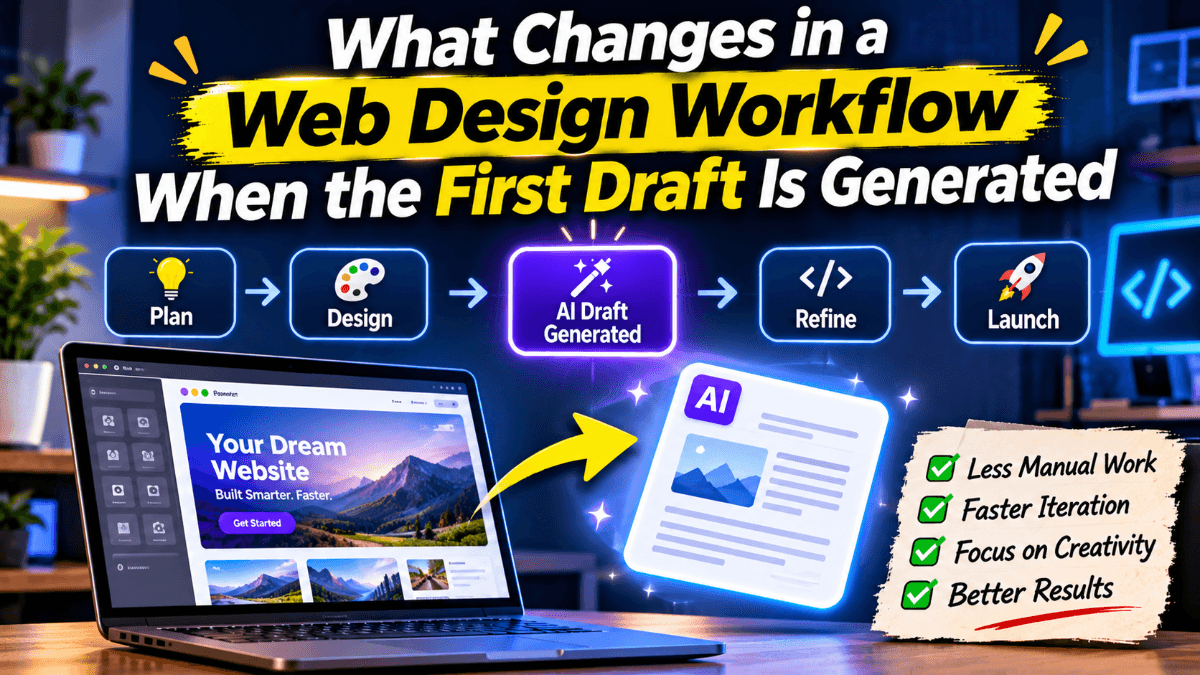
The version that works, in practice, looks roughly like this.
Step one: generate before the first meeting, not after. Spend ten minutes producing a draft from what you already know — the trade, the town, the rough positioning. Walk into the meeting with something on screen. The conversation immediately becomes concrete: "this section is wrong because we do not do commercial work," "that photo is nothing like our premises." You have extracted a brief by letting the client react to something rather than invent it.
This inverts the usual order. Normally the brief precedes the artefact. Here the artefact is cheap enough to precede the brief, and clients are much better critics than they are authors.
Step two: treat the draft as scaffolding with an expiry date. The generated layout gets you to a signed-off direction. After that, most of it should be replaced. The risk is not that AI output is bad; it is that it is adequate, and adequate survives into production when nobody has budget to argue with it. Decide up front which parts are placeholders.
Step three: spend the saved hours on the parts that differentiate. If generation saved you six hours of layout and placeholder work, those hours should go into the custom photography, the actual service descriptions, the local schema markup, the page speed work. That is where small business sites are won or lost, and it is exactly what gets cut when the budget is consumed by revisions.
Starting from a sector template instead of a blank prompt
One refinement worth mentioning: a blank prompt tends to produce blank-ish results. The output is only as specific as the input, and "build me a website for a dentist" is not specific.
Starting from a sector-specific layout gives the generator a much better starting point, because the structural decisions — what sections a dental practice needs, in what order, with what calls to action — are already encoded.
Most platforms now ship libraries of these; the website templates approach where each trade has its own prepared structure tends to produce something usable faster than a general-purpose prompt, for the simple reason that a booking-led layout and a quote-led layout are genuinely different and the difference is hard to describe in a sentence.
The practical test is whether the template encodes decisions or just decoration.
A template that is a colour scheme is worth very little. A template that knows a roofing company needs a project gallery and an emergency callout banner, while a med spa needs a treatment menu and a booking calendar, is doing real work.
Where this leaves the designer
The uncomfortable framing is that AI is coming for entry-level web work. The more accurate framing is that it is coming for the undifferentiated part of entry-level web work, which was already being eroded by template marketplaces and offshore production shops long before any of this.
What it does not touch:
- Understanding a business well enough to know what the site must achieve
- Making the thirty small judgement calls that separate a site that converts from one that merely exists
- Technical implementation beyond the brochure layer — integrations, performance, accessibility, anything with real data behind it
- Being accountable when it goes wrong
If your offer was "I will make you a five-page site," that offer is under pressure and has been for a while. If your offer is "I will figure out what your site needs to do and make sure it does it," generated drafts are a tool that makes you faster at the part you were never being paid for anyway.
A note on quality control
Two failure modes are worth watching for, because both are easy to miss and both damage a client.
Generic content at scale. If the copy could be swapped between two competitors without anyone noticing, it is not doing its job. Search engines have got considerably better at recognising this, and so have readers. Generated copy is a starting point for a rewrite, not a deliverable.
Invented specifics. Generated drafts will cheerfully produce opening hours, service areas, accreditations and years-in-business that nobody supplied. For a regulated trade — anything medical, legal or financial — publishing an invented credential is a genuine liability, not an aesthetic problem. Every factual claim in generated copy needs checking against something the client actually said.
The short version
Generated first drafts have moved a real bottleneck, and it is not the one the marketing talks about. They have not made production faster in any way that matters; they have made the pre-production conversation faster by giving everyone something to argue with on day one.
Used that way, the workflow is straightforward: generate early, use the draft to extract the brief, replace the scaffolding, and spend the recovered hours on the work that distinguishes the site. Used the other way — ship the draft, bill the client — it produces exactly the kind of interchangeable small business website that was already a commodity.
The tool is not the strategy. It never was.