A D-ring arrives with a published working load limit, a material certificate, and a test basis behind it. By the time it is attached to a deck, none of that describes the assembly anymore.
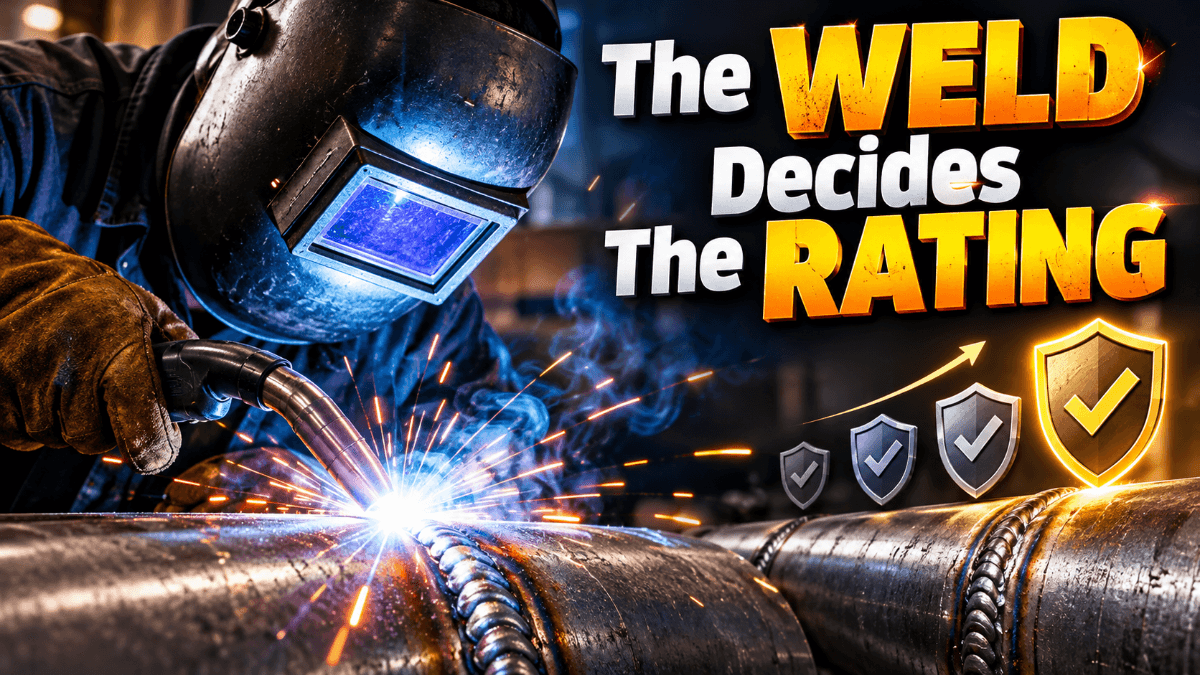
The component rating covers the component. What determines how much the installed anchor can actually take is the weld holding it there and the structure underneath it, and neither of those came from the manufacturer.
This is the gap that shows up in failure analysis. The ring is intact. The weld is cracked, or the plate it was welded to has torn out of the deck.
The Rating Belongs To The Part, Not The Installation
Manufacturers test and rate a fitting under controlled conditions with a defined load path. That figure is real and it is useful.
It also assumes the anchor is attached in a manner capable of transferring the load. A ring rated at several thousand pounds welded with a partial fillet by someone working quickly has a capacity set by that fillet, not by the casting.
Nobody stamps the installed capacity on the deck. So the number that gets used in the securement calculation is the component rating, and the system is assumed to have that capacity when it does not.
Federal cargo securement rules require the aggregate working load limit of the system to be at least half the cargo weight. That arithmetic only means something if every term in it is a verified number. An unverified weld makes one term unknown, and an unknown term makes the total unknown.
What Fails, And Where
Weld failures in securement hardware follow a short list of patterns.
Cracking at the weld toe is the classic fatigue location. Stress concentrates at the geometric transition between weld metal and base metal, and repeated load cycling initiates a crack there long before anything is visible under casual inspection.
Insufficient throat thickness is the most common workmanship issue. A weld that looks adequate on the surface may have far less effective cross section than intended, particularly where the joint geometry made access difficult.
Lack of fusion produces a weld that appears complete and has never actually bonded to the base metal along part of its length. It holds until the first significant load, then separates cleanly.
Base metal tearing is the outcome when the weld is stronger than what it is attached to. The joint holds and the parent material fails around it, which usually means the anchor was fixed to something not designed to accept that load.
Material Compatibility Is Not Optional
Welding a fitting to a structure requires the two materials to be weldable to each other, and that is not a given.
Cast components and rolled or formed steel behave differently under heat. Some castings require preheat to avoid cracking in the heat-affected zone. Some high-strength steels lose strength in that zone regardless of technique, which means the weakest point of the assembly ends up adjacent to the weld rather than in it.
Stainless welded to carbon steel is a specific case that comes up constantly in marine and de-icing environments. It is done, with the right filler, and it creates a galvanic couple at the joint that will corrode the carbon steel preferentially. The fitting stays sound while the deck around it deteriorates, which is worse than uniform corrosion because inspection attention goes to the fitting.
Specifying weldable D-rings for a job means confirming the base material of both the fitting and the receiving structure, then selecting filler and procedure accordingly. A weld made without knowing what the parent metal is has no predictable properties.
Container Structure Does Not Take Point Loads Anywhere
For shipping containers this is the most consequential item and the most frequently ignored.
A container carries load through its corner castings and the rails connecting them. That frame is engineered for stacking loads and for lifting. The side and roof panels are a skin. They provide enclosure and shear stiffness, and they were never designed to accept concentrated tension at an arbitrary location.
An anchor welded to a side panel is attached to sheet material. Under load the panel deforms, the weld pulls, and the failure mode is a torn panel rather than a broken fitting. The repair is structural.
Anchors intended to carry real load need to land on the frame or on a reinforcing plate that distributes into it. Adding an anchor to a container is a structural modification, not hardware installation, and on any container still in CSC-certified service it has certification implications that outlast the job.
Bolt-On Trades One Problem For Another
Bolted installation removes the weld quality question entirely, which is why it is often the better choice.
It replaces it with backing plate sizing, thread engagement, torque specification, and resistance to loosening under vibration. Those are more inspectable than a weld and more predictable to specify, but they need specifying.
The failure mode with bolted anchors is usually gradual loosening followed by elongation of the bolt holes, at which point the fitting moves under load and the movement accelerates. A bolted anchor that can be rocked by hand has already lost a significant portion of its capacity.
Where load is high and access allows, welded gives a stiffer, more permanent connection. Where structure is uncertain or the installation may change, bolted is easier to do correctly and easier to verify afterward.
What Documentation Looks Like
After an incident the questions are consistent and narrow.
What was the anchor rated for, and by whom. What procedure was the weld made to, and was the welder qualified for it. What was the base material. What structural member was the load transferred into, and was it checked. When was the installation last inspected and by what method.
An operation that can answer those has defensible practice. One that can produce only a photograph of a failed fitting does not, and the analysis moves from the incident to the maintenance program behind it.
Visual inspection catches gross defects. It does not catch lack of fusion or subsurface cracking, which means high-consequence installations need a method that does, on a documented interval.
The weld takes minutes and determines everything downstream of it.