Let’s say you want to use AI in your business, maybe for a tool to predict what customers will buy next, or for a helper to answer customers’ questions. This means that you need AI/ML Developers.
The question of whether to hire an in-house team or an offshore team for AI/ML development for your company is a big one.
In-house developers work inside your company, either on-site in your office or as full-time remote employees. Offshore developers work for another company in another country and create solutions for you from there.
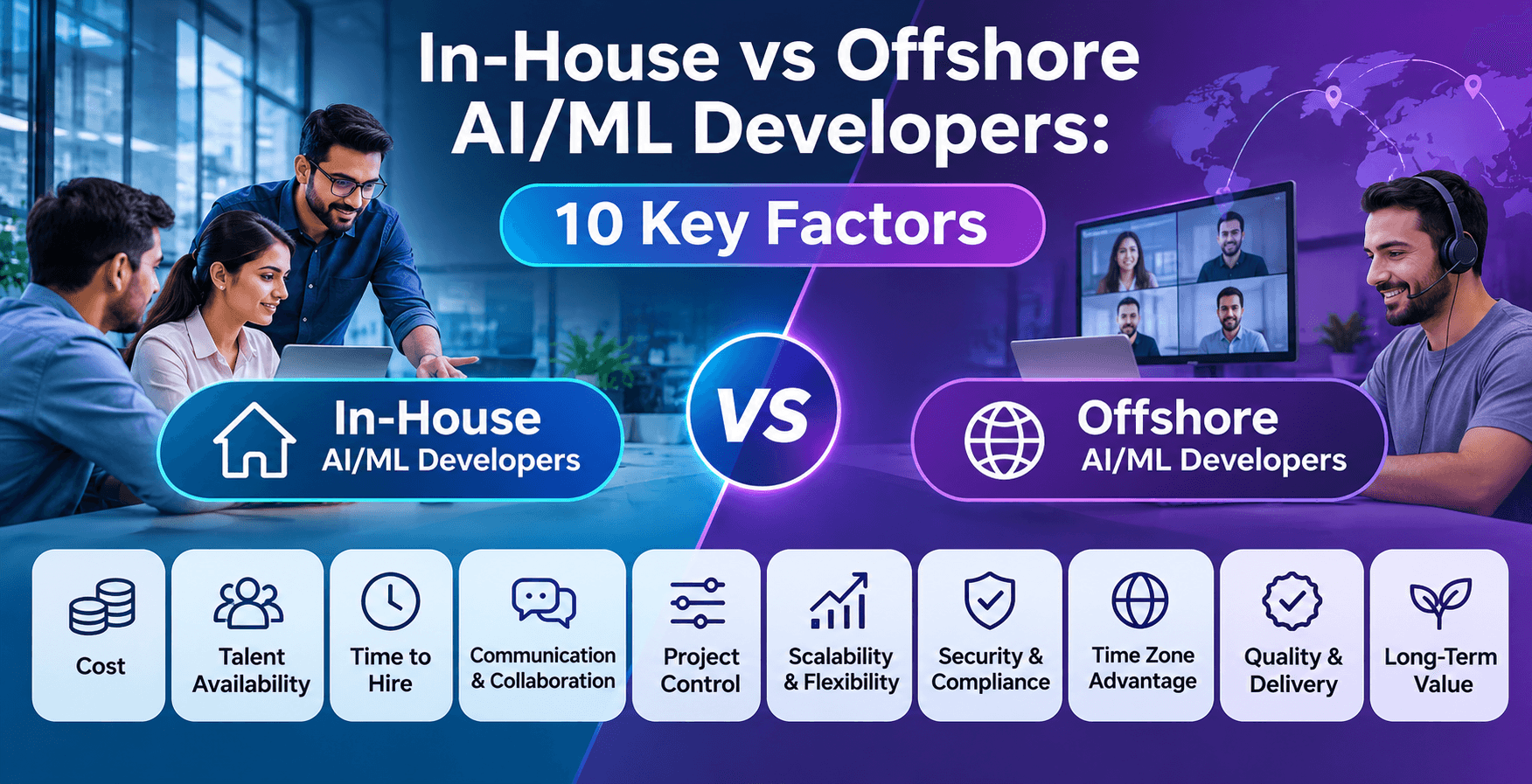
No matter whether you choose to Hire AI ML Developers from an offshore company or not, there are ten factors that you should consider.
1. Cost
As mentioned above, the cost of in-house employees is more than just their salary. You pay for their health care, for their laptop, desk, etc. as well as for their training. If they leave, you even have to pay for the cost of finding a new employee.
In general, the costs of offshore developers are lower than those of in-house developers. The monthly cost of offshore developers often covers many additional services.
2. How fast you can start
First, you have to write a job description. Then you read through hundreds of resumes. You interview dozens of people. Then you wait for them to leave their current job. This process can take months.
Most offshore companies have a pool of people ready to start on your project within a few weeks.
3. Finding good people
There are many cities where it is very hard to find good AI workers. Big companies can afford to pay high salaries and therefore many AI workers are taken by them.
In other countries there are many more people with the right skills to choose from.
4. Being in charge
The in-house team is right in front of you and can be contacted anytime. You can establish rules and enforce them.
However, even if the team is located in another country, you can still be in charge. You need to plan more though, set clear goals, hold regular meetings and use the same tools as the team.
5. Talking to each other
Offshore teams may be in a different time zone. When it is morning for you, it may be night for them. Language can also cause mix-ups.
Many offshore teams work some hours that match your day. They use chat and video calls to stay in touch. Always ask about this before you start.
6. Knowing your business
In-house workers learn about your business over time. They get to know your customers and how things work.
While offshore developers can learn about your business as well, they will need some help in the beginning. Provide them with notes, let them see how your business works, and allow them to ask questions.
7. Keeping data safe
Most of the data used for AI projects contains some private information, e.g. names of customers or even sales figures. It is much easier to keep such data safe if all of it is located within the company’s premises.
With offshore teams you need to define the rules in the contract for access to the data, where the data is stored, etc. If the data is subject to privacy laws, you should check those laws as well.
8. Growing and shrinking
Maybe you need more people for three months and then fewer. This is easy with an offshore team. You just ask for more people, then fewer later.
This is much harder to do with your own team. Hiring takes time, and letting people go is hard for everyone.
9. Keeping what people learn
If AI is the main thing your company sells, you want your in-house people to know how it works for many years to come.
Offshore teams can change over time. So ask them to write down everything they build. Also make sure the code belongs to you.
10. Managing the work
In-house workers need a boss, check-ins, and training. That takes time from your managers.
Most good offshore companies will help you with some of the above but you will still need one person on your side to manage the work and make decisions.
Who should pick in-house?
In-house is a Good Choice If:
AI is the main thing your company sells
Your data is very private
The work will go on for many years
You have enough money to hire and keep good people
Who should pick offshore?
Offshore is a Good Choice If:
You need to start fast
Your money is limited
You want to test an idea before spending a lot
The project has a clear start and end
You can do both
Many companies have a small in-house team to make the big decisions for the business and use an offshore team to build and test things.
This allows you to keep control over the most important aspects of your business, while still saving money. You just have to make sure that the two teams work as one team, and that you let them communicate with each other, use the same tools, and work towards the same goals.
A Simple Money Example
For example, let’s assume that you need three AI developers for one year.
You will have to pay three salaries. You will have to provide them with equipment, benefits, and even pay for the cost of hiring them. If one of them leaves after 6 months, you will have to hire a new person, which will take weeks.
With an offshore company you usually pay a monthly fee for each worker. If someone leaves, the company sends a new person. Prices are different in every country, so ask both sides for the full cost before you pick.
Mistakes to Avoid
Here are some common mistakes:
Picking only the cheapest offer.
Cheap work can turn out badly and cost more to fix.
Not writing things down.
If nobody keeps notes, the knowledge leaves when the person leaves.
Having no clear goal.
If the team does not know what you want, they will build the wrong thing.
Forgetting about help after launch.
AI tools need checking and fixing even after they go live.
All of these can be easily avoided by writing down your goals, defining how you will check progress, and ensuring that all code and data is owned by you.
How to decide
Here are three easy steps:
Write down your top three needs. It could be low cost, fast start, or strong control.
See which choice fits those needs best.
Try a small project first. Pick one small task and see how the team works. After a few weeks, you will know a lot about how they talk, how good their work is, and whether they fit.
A small test is better than a long sales pitch.
Conclusion
There is no one right answer. In-house teams give you more control and deep knowledge of your business. Offshore teams give you speed, savings, and room to grow. Many companies end up using a bit of both.
Think about what matters most to your company right now. Pick the choice that fits and be ready to change it later. Your needs may grow, and your team can grow with them.