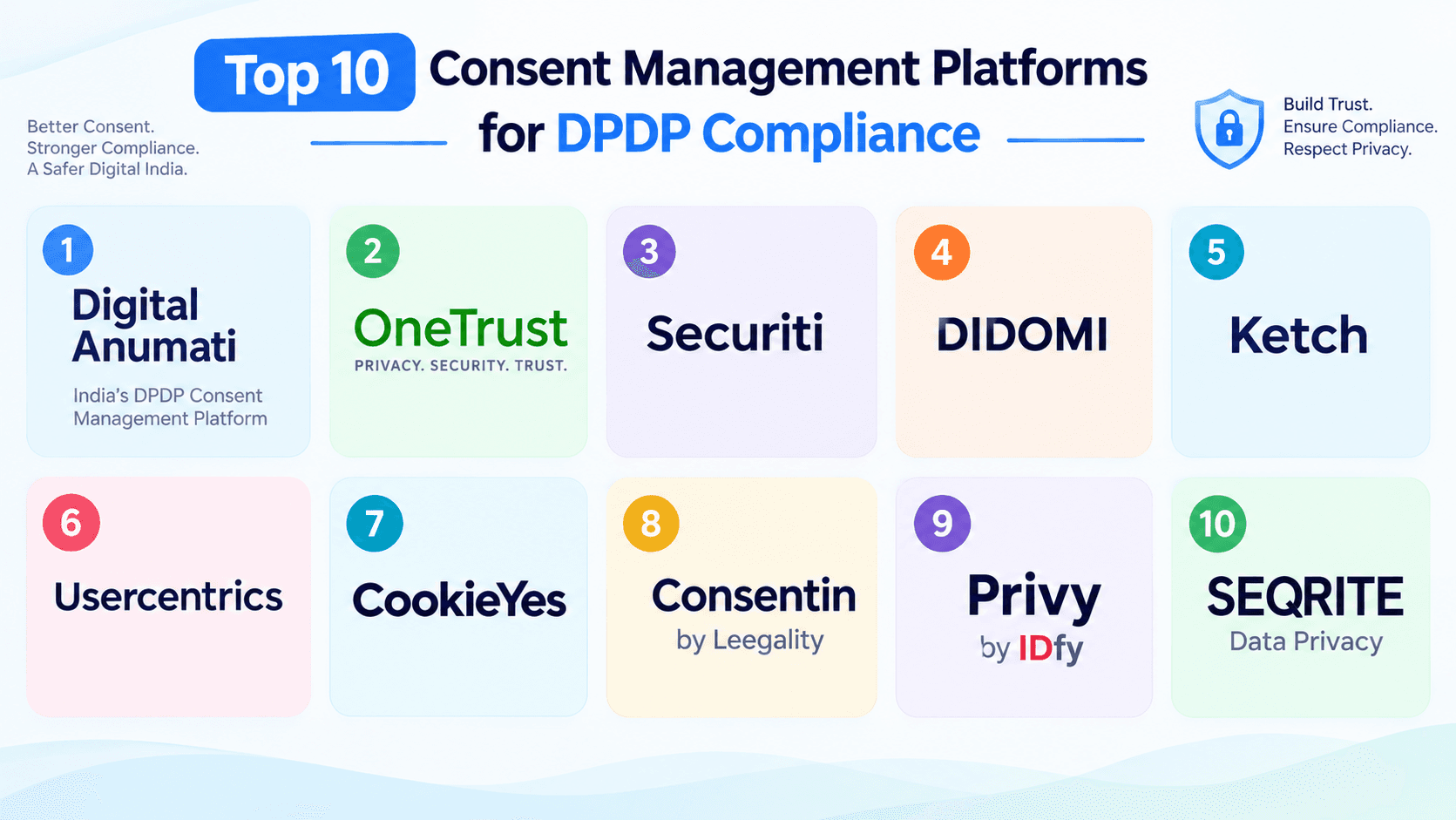
India's data privacy landscape is evolving rapidly with the Digital Personal Data Protection (DPDP) Act, 2023 and the DPDP Rules, 2025. As businesses collect and process increasing amounts of personal data, managing consent in a transparent and structured manner has become an important part of privacy compliance.
A Consent Management Platform (CMP) helps organisations collect, record, manage, and withdraw consent while maintaining appropriate records and audit trails.
From India-focused solutions to global privacy platforms, businesses have several options to consider. Here are 10 consent management platforms that organisations can evaluate for their DPDP compliance requirements.
1. Digital Anumati
Digital Anumati is an India-focused Consent Management Platform for DPDP designed to help organisations manage the complete consent lifecycle in a structured and auditable manner.
The platform focuses on helping businesses capture, record, manage, and withdraw consent across relevant digital journeys. Instead of limiting consent management to website cookie banners, Digital Anumati can support broader consent requirements across business processes.
Key Features
Purpose-based consent management
Digital consent collection
Consent records and audit trails
Consent withdrawal and preference management
Centralised consent visibility
Integration capabilities
DPDP-focused consent workflows
Digital Anumati can be relevant for organisations across industries such as banking, insurance, healthcare, e-commerce, SaaS, technology, and consumer businesses.
For organisations preparing for India's evolving privacy requirements, a structured consent management system can help replace manual consent tracking and provide better visibility into consent status.
However, a CMP alone does not make an organisation fully DPDP compliant. Businesses must also address privacy notices, security safeguards, Data Principal rights, retention, breach management, grievance handling, and other applicable requirements.
2. OneTrust
OneTrust is a global privacy management platform offering consent and preference management along with broader privacy and governance capabilities.
Its features include cookie consent, data discovery, privacy assessments, data mapping, and privacy rights workflows.
Best suited for: Large enterprises and multinational organisations.
3. Securiti
Securiti combines consent management with data discovery, privacy governance, security, and compliance automation.
It can help organisations connect privacy controls with their wider data environment.
Best suited for: Data-intensive enterprises with complex technology ecosystems.
4. Didomi
Didomi focuses on consent and preference management across websites, mobile applications, and digital experiences.
Its capabilities include consent collection, preference management, cookie consent, analytics, and integrations.
Best suited for: Digital businesses managing multiple online properties.
5. Ketch
Ketch provides consent and permission management capabilities designed to connect privacy preferences with an organisation's wider data ecosystem.
The platform includes consent management, preference management, permission controls, APIs, and data-use controls.
Best suited for: Enterprises managing consent across multiple systems.
6. Usercentrics
Usercentrics provides consent management solutions for websites and applications, with a focus on digital consent experiences.
Its capabilities include website consent, mobile consent, cookie management, preference management, and integrations.
Best suited for: Businesses managing consent across websites and apps.
7. CookieYes
CookieYes primarily focuses on website cookie consent and related compliance workflows.
It provides features such as cookie scanning, consent banners, consent logs, and website integrations.
Best suited for: Websites, publishers, SMBs, and businesses primarily requiring cookie consent.
8. Consentin by Leegality
Consentin by Leegality focuses on digital consent collection and consent-related workflows.
It can help organisations capture and maintain consent records during digital onboarding and documentation processes.
Best suited for: Indian businesses with consent-heavy onboarding workflows.
9. Privy by IDfy
Privy by IDfy is a privacy-management solution designed for organisations operating in India's evolving data protection environment.
Its capabilities include consent management, privacy notices, data discovery, assessments, and compliance workflows.
Best suited for: Indian enterprises looking for broader privacy-management capabilities.
10. Seqrite Data Privacy
Seqrite Data Privacy combines privacy management with a broader cybersecurity and data protection ecosystem.
Its capabilities include data discovery, classification, consent management, Data Principal rights workflows, and compliance reporting.
Best suited for: Organisations looking to connect privacy management with security operations.
How to Choose a Consent Management Platform for DPDP Compliance?
Choosing a CMP should involve more than checking whether it provides a consent banner. Organisations should evaluate the platform based on their actual data-processing environment.
Purpose-Based Consent: Can the platform associate consent with specific processing purposes?
Consent Records: Can the organisation maintain evidence of when and how consent was collected?
Consent Withdrawal: Can users easily withdraw or modify their consent?
Audit Trails: Does the platform maintain a reliable history of consent and preference changes?
Integrations: Can it integrate with CRM, websites, mobile applications, marketing platforms, analytics tools, and other systems?
Scalability: Can the solution support multiple websites, applications, business units, and customer journeys?
Broader Privacy Requirements: Can the platform complement other DPDP processes such as Data Principal rights, privacy notices, data governance, security, and retention?
Common Mistakes When Implementing Consent Management
- Treating Cookie Consent as Complete DPDP Compliance: A cookie banner addresses only one specific consent use case. DPDP compliance involves much broader organisational processes.
- Using Blanket Consent: Businesses should consider whether consent is appropriately linked to the relevant processing purposes.
- Ignoring Consent Withdrawal: Consent management should cover both consent collection and withdrawal.
- Maintaining Disconnected Consent Records: Consent information should be accessible to the systems and teams that need to act on it.
- Selecting a Platform Without Mapping Data Flows: Organisations should understand where personal data is collected, why it is processed, which systems use it, and which third parties receive it before implementing a CMP.
Conclusion
As India's data protection ecosystem continues to evolve, organisations need to move beyond manual consent collection and basic website banners. A modern Consent Management Platform can help create a more structured approach to consent collection, record keeping, preference management, withdrawal, and auditability.
The right solution depends on an organisation's size, industry, data environment, technology stack, processing purposes, and broader privacy programme. For Indian organisations specifically evaluating consent management for the DPDP ecosystem, Digital Anumati is one option to consider alongside global and India-focused privacy platforms.
Frequently Asked Questions10 FAQs
Quick answers to common questions about this topic
A Consent Management Platform is a software solution that helps organisations collect, record, manage, monitor, and withdraw user consent for personal-data processing.
The DPDP framework does not simply require every organisation to purchase a particular CMP. However, organisations need appropriate processes to meet their applicable consent and data-protection obligations. A CMP can help operationalise those processes.
No, A cookie banner addresses a specific website consent requirement. DPDP compliance involves several other areas, including notices, rights, security, retention, grievance handling, and applicable processing obligations.
Depending on the organisation's requirements, consent records may include consent status, purpose, timestamp, relevant notice or policy version, collection channel, and withdrawal or preference changes.
Consent withdrawal allows individuals to change their preferences. Organisations should have appropriate processes for handling withdrawal and determining what happens to the associated processing.
Many modern CMPs support multiple digital channels. Organisations should verify the platform's specific website, mobile, API, and integration capabilities before implementation.
A CMP can help maintain structured consent records and audit trails, making it easier for organisations to demonstrate how consent was collected and managed.
A CMP is generally a software platform used by organisations to manage consent. A Consent Manager is a specific concept under the DPDP framework with regulatory requirements. The two terms should not automatically be treated as interchangeable.
Almost any organisation processing personal data can have consent-management requirements, including banking, insurance, healthcare, e-commerce, SaaS, telecommunications, education, and consumer technology.
No, A CMP can support consent-related processes, but DPDP compliance involves a wider set of legal, technical, organisational, and governance requirements.