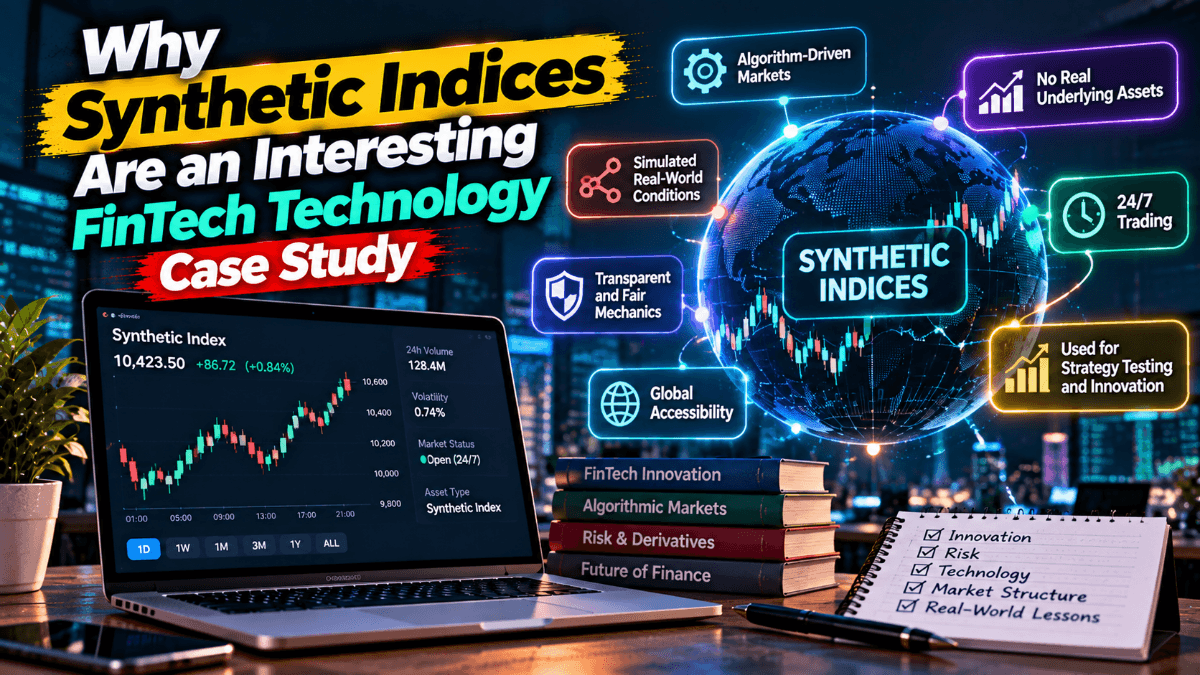
Financial Technology (FinTech) has advanced well beyond simply moving traditional financial services online. Today, enhanced software applications can produce data, automate processes, model complex systems, and create a fully digital financial environment. Synthetic indices are an interesting FinTech technology case study because they combine mathematical modeling, algorithms, probability, data generation, and digital infrastructure.
Instead of viewing these instruments from a purely trading perspective, they can be studied as financial systems that are built on software. Their behavior is a product of programmed rules, while complex backend processes are replaced with information that can be interacted with by users on digital platforms via charts and other interfaces.
To really comprehend the technology, you can study how software architecture, algorithms, and data combine with financial engineering.
What Makes Synthetic Indices Technologically Different?
The financial markets are very much intertwined with the world economy. Stock prices reflect corporate profits, currencies reflect monetary policy, and commodity prices reflect supply and demand. Synthetic markets differ. A synthetic instrument is created through webbed mathematical rules, rather than the ownership of a physical good. Their behavior can capture volatility, probability, price movement, and other statistical characteristics.
This creates a distinction between a financial product and the technology that underpins it. Instead of being driven by external economic conditions, data is generated based on set rules. From a FinTech perspective, it is an example of software that produces selected market features without replicating the real economy.
The Role of Algorithms
The synthetic indices algorithm is at the core of the technology. It is the computational world logic of how the digital environment behaves and how the price data is generated. Algorithms define the mathematics that define volatility, probability, frequency, and movement patterns. By changing the mathematics, different instruments can have different statistical characteristics.
This is what makes synthetic markets fascinating from a software development point of view. Developers can see how mathematical directions produce a continuous stream of outputs, while data scientists can examine distributions, characteristics, correlations, etc. The point is that the algorithm is more than a financial service support system. It helps define the behavior of the digital environment.
Data Generation and Mathematical Modelling
Data is a crucial ingredient of modern FinTech. Banks, payment platforms, investment systems, and financial apps all rely on proper data handling. Synthetic environments bring another ingredient: data which can be generated by mathematical models. Rather than collecting observations from an outside market, the system creates new data digitally following its own rules.
This allows synthetic indices to be used for computational modeling research. For researchers, it opens the possibility of studying how mathematical parameters affect a data set, or if analytical techniques behave differently with synthetic data versus a traditional data set.
For instance, a model with a certain volatility behavior will create an environment with different statistics than a model with different inputs.
Understanding Digital and Physical Markets
Technology also changes the kind of information you need to analyze. When analyzing real-world assets, you might look at economic indicators, company results, geopolitical events, or real supply and demand. With real synthetic indices, the key question is different: what are the rules and underlying programming that produce the behavior?
This is an illustration of how financial engineering can produce a situation where the relationship between an underlying asset and displayed data is different. For FinTech researchers, this illustrates how financial products can be software products, defined and analyzed through algorithms, mathematical assumptions, data structures and programming.
Digital Infrastructure Behind the User Experience
The algorithm is only the tip of the iceberg. Users also need to understand the underlying digital infrastructure and know that it is capable of reliably providing up-to-date values. A platform will need to execute on the data set, refresh prices, display charts, maintain account information, and provide well-designed controls through the interface.
An illustration of how this technology is wrapped within a digital financial ecosystem can be seen in Weltrade’s synthetic indices. The user would normally have no direct contact with the mathematical engine. Instead, the backend delivers the sophisticated calculations into an easy-to-understand interface.
It is normal in FinTech for complex infrastructure to run below the surface of what the user experiences in the digital layer.
Automation and Continuous Processing
Once the base rules are programmed, the system automatically generates and processes information continuously rather than one data point at a time manually. Technology can reduce the need for manual input in this way.
Continuous processing creates additional infrastructure requirements. Systems must remain responsive, maintain continuity of data, compute calculations, and effectively communicate information from one software component to another. These challenges arise in payment processing, automated investment platforms, bank applications, and FinTech systems.
Synthetic Markets as a Testing Environment
The programmable nature of these platforms can also help with financial technology applications and financial data analysis. Software can respond to continuously generated data sets. Data science can test various statistics, while mathematical research could explore the impacts of assumptions.
This is where synthetic indices strategies could be understood from a software design perspective rather than a purely acquisition and trading perspective. A strategy can be seen as a set of computational instructions that respond to new data and generate a defined response. The key point is that financial technology is full of systems that interpret information and apply a set of predetermined rules.
Portfolio Technology and Data Relationships
This perspective could also be applied to software that manages multiple digital financial instruments. A synthetic indices portfolio is multiple streams of information derived from custom data feeds. Software can compare those data sets, generate contextual relationships, and produce dynamic statistics. Software can also provide dashboards and other analytical tools.
This illustrates the increasing role of data processing in FinTech. Apps today are not just about displaying information, but increasingly turning raw data into structured insights.
Why Understanding the Technology Matters
In understanding synthetic indices, you can’t just focus on the movements you see on a chart. You’ve got to dive deeper into the underlying factors like the mathematical models, algorithmic rules, the data-generation process, and the software infrastructure that delivers this information. This broader perspective pushes you to think more critically about financial technology. You can investigate what creates the data, what rests in the assumptions embedded in the technology, how the information is processed, and what constraints the technology itself imposes.
Security and the reliability of the system matter too. Any digital financial environment requires protection of account information and transmission of data, system availability, and operational integrity.
These ideas expand the scope of FinTech. It is not just about building financial products. It’s also about building robust technological systems around them.
A Broader FinTech Case Study
The relevance of synthetic indices extends beyond these instruments themselves. They also illustrate the convergence of finance, mathematics, software engineering, statistics, and data science.
For developers, they are an example of algorithmic financial engineering. For data scientists, they are an example of generated data sets that can be statistically examined. For FinTech researchers, they are an example of environment-building software, an illustration of how market-like environments can be built through software programming, as opposed to physical economic activity.
They also point to an interesting genre of financial technology: technology that moves from the digitization of existing activities to the design of software-based financial worlds that are digital from the start.
Conclusion
Synthetic indices make an interesting FinTech technology case study because they illustrate a technology that uses mathematical models and software to build a financial environment that is continuously generated over time. The importance of FinTech technology, however, lies not in the trading aspect, but in what makes the financial environment possible: Algorithms bring about behavior, mathematical models shape data, software infrastructure delivers information, and digital interfaces make complex systems usable. Together, these aspects illustrate how modern financial technology, at the intersection of computer science and financial engineering, can build new digital financial worlds.
The study of this technology also provides an instructive point of view on the future directions of FinTech toward financial worlds that are built as software-driven ecosystems, rather than just digitalized replicas of traditional financial systems.